


Dear Friends,
Three multifamily deals came in at roughly the same time. We were interested in all three, but by the time the team finished underwriting, reviewing assumptions, running scenarios, and deciding whether to submit LOIs, the brokers had already moved to best and final.
The Lesson: We didn’t lose because of capital, relationships, or price. You lost because your process was too slow.
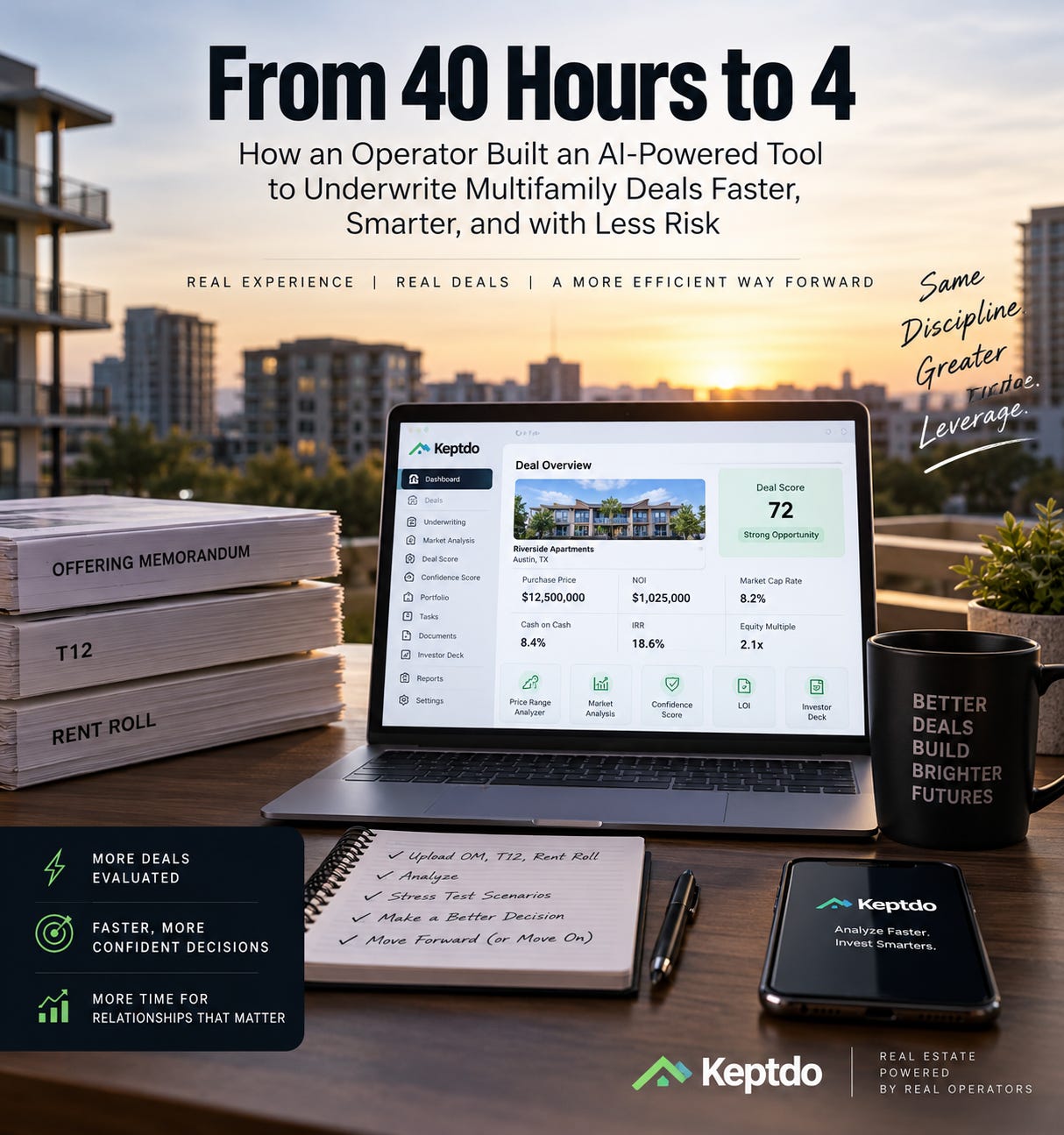
What 40 Hours Really Looked Like
When a broker sent us a deal, we would receive the offering memorandum, a trailing 12-month operating statement and rent roll.
Then the work started.
Sometimes the files weren’t in the format we needed, so converting them could take an hour.
Then we had to parse and reorganize the T12 and rent roll so the information fit the structure required by our Excel underwriting model.
Another Hour.
Importing and verifying everything in the model could take another hour. Then we run our 38-point market analysis, which could take roughly four hours. The initial underwriting took about an hour.
Then we spent another hour deciding whether the property was even worth moving into what we called Level 2 underwriting. If it made it through the filter, the deeper underwriting could take another three hours.
Scenario analysis might take three more.
Then came one of the most important parts: actually, analyzing the deal and determining whether the assumptions made sense. That could consume another 5 hours and then we wanted other people on the team to look at the deal and give us their perspective. We always ask for a second set of eyes matters when you’re making decisions involving millions of dollars.
That review, the back and forth, revisions, different assumptions and rerunning scenarios could easily add another 10 to 15 hours.
All in, a deal could consume roughly 40 hours of our attention before we were comfortable making an LOI decision.
We like to be thorough, but the problem is that the market doesn’t wait for you to finish your analysis.
The Three Deals That Changed Everything
Missing those three opportunities made something very clear to me:
Speed had become a competitive advantage.
That doesn’t mean to make reckless decisions just to move faster.
It means getting to an informed yes or no fast enough that you actually have the opportunity to act.
I had spent 25 years working in Information Technology, and at the same time I was becoming increasingly interested in Artificial Intelligence.
After we missed those opportunities, I kept thinking:
There Has to Be a Better Way
I didn’t immediately know exactly what the solution needed to look like, but I started asking different questions:
What if I could use AI and software to build a SaaS application that did much of what I was already doing manually?
What if we could take the repetitive parts of the underwriting process, automate them, reduce errors and get to an investment decision substantially faster?
What if the system could do something else our traditional Excel model couldn’t easily do?
What if it could challenge our assumptions?
That became the beginning of Keptdo Multifamily Deal Analyzer Pro
Building It as an Operator
I build KeptDo myself. That was very important to me. I wanted to build something functional that would work for operators like me and investors.
I did not want to start with software and then figure it out or hire developers that never analyzed a deal and try to show them how to do it.
From the beginning I wanted to build something that had a genuine feel for what an operator goes through in analyzing a deal and making a yes or no decision.
So, I started with how I actually start to analyze a deal and build the software around that process.
Standardizing the Inputs
The first problem we tackled was the broker documents. Every broker packages information differently, but before we could automate underwriting, we had to create a repeatable way to standardize what came into the system. We started by building a standard parsing method for the OM, T12, and Rent Rolls.
Once we had the standard parsing figured out, we could move on to building the underwriting engine.
Rebuilding the Underwriting Model
The underwriting model had to closely mirror what I was already doing manually. It had to follow the Excel Model we were using but automate and make it better. To do this we had to run multiple iterations.
I performed various financial verifications and code verifications to ensure accuracy. Speed is worthless if the numbers aren’t accurate.
The major calculations we focused on included NOI, market Cap Rates, along with KPIs we use to evaluate investments:
Cash on Cash Returns
Internal Rate of Return
Equity Multiple
I repeatedly compared KeptDo’s outputs with our existing model and ran verification tests against the Excel model for accuracy. I wasn’t comfortable using the application on actual investments until the KPIs matched what I knew I trusted.
Only after reaching that point did I start to expand the system and add additional modules for increased functionality.
We added functionality around the Capital Stack, Investor Journey, Deal Scoring, Confidence Score, Market Analysis, Portfolio Tracking, Kanban Board, Deal Notes, Taxes Module, LOIs, Pricing Module, Scenario and Sensitivity Analysis, LOIs and Pitch Decks, Reporting, and much more.
Why the Confidence Score Matters
One of the things I wanted to build was a way to measure my assumptions versus market dynamics. The old process did not have this. I wanted a way to challenge my assumptions and mitigate risks.
The Confidence Score looks at four broad areas and gives it a weight to produce an overall score.
Deal Projection Feasibility
Financials
Market
Operational Risk
The goal is to ask: How likely is it that the assumptions you are making are reasonable? and What might you be missing?
That gives me the opportunity to question an assumption before putting in real money behind it. Maybe I change the assumption, maybe I don’t, but I want to know why.
I think of this as having an expert review the assumptions you're making in the deal before you pull the trigger.
What 40 Hours to 4 Looks Like Today
Today, the process looks very different.
Deal Comes in I upload the OM, T12, Rent Roll. It does the automatic parsing and loads it to the system. Usually Takes 5 minutes
I save the deal and start looking at the automated Deal Score.
If the automated Deal Score is below 50, I will sometimes modify the price 10% -20% to see whether the opportunity changes materially. If it still doesn’t go past 50, I usually pass and move on. This saves me roughly 10 hours or so not having to determine if this is a good deal or not.
If the score falls between 50-65, I will spend roughly 30 minutes to 1 hour reviewing the assumptions and making sure they accurately reflect what I know about the market. If the score still doesn’t pass 65 I move on.
If it scores 65 or higher that is when I start analyzing, it deeper.
I will run the Price Range Analyzer to see what price range looks like for a possible offer.
I will run the Market Analyzer to check what the market score looks like, understand the strength and weakness in the market. See how it scores on specific criteria.
I will run the Confidence Score to understand my assumptions and how accurate they are seeing what the risks are and what I should or should not change.
I will run scenario and sensitivity analysis to see what a best worst and normal case returns look like.
I will run a break-even analysis to see what the occupancy needs to be at for use to be able to pay our investors and see what the occupancy needs to be at before we have to do a capital call. This helps us understand the risk to investors. We typically like to make sure that occupancy has to be at 75% or lower before a capital call is ever an option. This also tells us how long we have at a given occupany rate before we have to ask for additional capital.
I verify the KPIs and see if it meets our minimum standards.
This analysis takes about 2 hours and at this point we have enough information to decide if we will submit an LOI or not.
What used to take 40 hours can now often be accomplished in around 4 hours.
The Real Benefit Is Getting to No Faster
The biggest benefit is getting to No faster. That is a distinction I did not fully understand and appreciate when I first build this. Understanding what not to invest in is even more important than understanding what to invest in. Not having your time wasted on deals that will never meet your KPIs is huge. This prevents a waste of time and allows you to focus more on good deals and building relationships and partnerships when you do get a deal.
100 Deals Analyzed → 10 Deeper Analysis → 2 Serious LOI Candidates
In the last two weeks alone, we analyzed approximately 100 deals.
10 made it to deeper analysis.
2 Became serious candidates for LOI submission
Think about what that means. If every one of those 100 deals had required anything close to our old process, it would have been impossible.
Instead, we are able to quickly determine which opportunities do not fit our criteria and focus our energy on the small number that might.
This also allows to deepen our relationships with brokers. I don’t believe a software can replace this, but every hour you are not buried under a financial model or underwriting means that is an hour you have available to build a relationship with a broker or a potential partner, attend community and business events, or raise capital.
KeptDo doesn’t find deals for me. It helps me determine whether the deals we are finding are actually good for us.
AI Should Not Make the Decision
This is also where I think people can misunderstand AI. I don’t believe AI should make the investment decision. When millions of dollars are on the line, I don’t want to blindly hand that responsibility to an algorithm.
AI should be used to help you the Human make the decision. It should be used to reduce risk and model behavior and scenarios. It should help you understand where the analysis is coming from, where the assumptions you are making could be wrong, and help you mitigate risk. It should help answer questions like:
What happens if the rents to grow as expected?
What if expenses are higher than we thought?
What does our occupancy rate have to be at year 1 to be able to distribute quarterly payouts to our investors?
What happens to the investment downstream if the assumptions change?
AI can help see those relationships faster, but it still a tool. It does not replace human thinking. It does not replace due diligence, and it does not replace walking the property and experiencing the area. The operator still has to make the decision.
My goal is to simply arm the operator with the best information possible to make a decision as quickly as possible.
Conclusion → Speed + Judgment
Speed without judgement is just faster risk. I believe speed has become a real competitive advantage in multifamily, but there is an important qualifier.
Moving quickly isn’t valuable if you're moving quickly towards the wrong decision.
The opportunity is to combine speed with better judgement. That is what I tried building with KeptDo.
Something that could take many of the things we were doing manually, automate them, reduce errors, challenge assumptions, and help us understand a deal quickly enough to actually act.
It Started because we missed three deals.
Today, the bigger value is that we can look at 100 opportunities and recognize that only 10 deserve a deeper look. Saving us a huge amount of time. That is what real efficiency looks like. It’s not about doing 100 deals faster is about knowing which 90 deals to pass on and what 10 deals to focus on deeper.
For newer operators I think that kind of structure can be incredibly valuable because it helps create a repeatable process for analyzing opportunities.
For operators with portfolios from roughly $5 million to $200 million, I think there is also an opportunity to reduce the amount of manual work involved in evaluating acquisitions freeing you up to build relationships, grow partnerships, and analyze more deals.
For larger organizations with dedicated underwriting teams, the question is different.
Can Technology Augment What Those People Are Already Doing?
Can it remove repetitive work so highly paid professionals spend more of their time on judgement, relationship building, and the part of the investment process that actually require human expertise?
Those are the questions that the industry will have to answer.
For me the answer started with a much simpler question:
There has to be a better way.
Call To Offer
If you underwrite multifamily deals and want to see whether this approach could fit into your own operations, you can try Keptdo with a 14-day free trial at https://keptdo.com
If you rather see how I personally use it, reach out to me. I am happy to schedule a call and a walk-through demo with you.
Because the point isn’t to let AI make your investment decisions, it’s to help make better ones before the opportunity passes you by.
Taking It Apart
This is me Taking It Apart if you found this valuable, I humbly ask for you to subscribe and share the newsletter with others whom you think will find value.
Contact Information
Who am I?
I have been in Information Technology for over 25 years at various roles from Systems Engineering to Director lever positions. I have also been in real estate since 2019 focusing on fix and flips and in 2023 we shifted our focus to commercial real estate investing. I have acquired 246 units and continue to pursue real estate investments. I also have a Technology Firm helping companies incorporate technology, build systems integrations, and solve complex business problems. An example of this was our Multifamily Deal Evaluator application that was built with an operator, syndicator, and investor perspective so that anyone can learn to underwrite, analyze, and evaluate deals. If you are interested in the tool, you can check it out at KeptDo MFA PRO.
If you like to learn more about what we do to help small and mid-size businesses get more customers, make each customer worth more, and spend less to service them please visit Del Val Investment Group.
Outside of my family, my dog, and my Miami Hurricanes my passion is business, technology, and real estate. We are always looking to purchase businesses that have a unique niche and serve our vision of solving real world business problems with technology and we are always looking for JV real estate opportunities we can operate or invest in as joint partners.
If you would like to reach out or learn more about my background, or if you have a business, you are looking at selling or looking for a partner, or if you want to invest with us feel free to connect with me on the following platforms.

Manny Del Val | CEO and Founder Del Val Investment Group
the five silent trials next to the two relationship groups is the diagnosis, not a mystery. the product earns trust through you right now, so the useful question is what you do in that first session that the software doesn't do alone yet. record yourself onboarding the next group, watch for the moment they lean in, and move that moment into the product.
on activation: the aha for this product is "i uploaded a messy rent roll and watched it land in the model clean." everything in the trial should funnel to that moment in the first ten minutes. a signup that never uploads a deal was never really a trial.
the live underwriting sessions are the right call. a real broker package going from documents to decision in front of people beats any ad.