

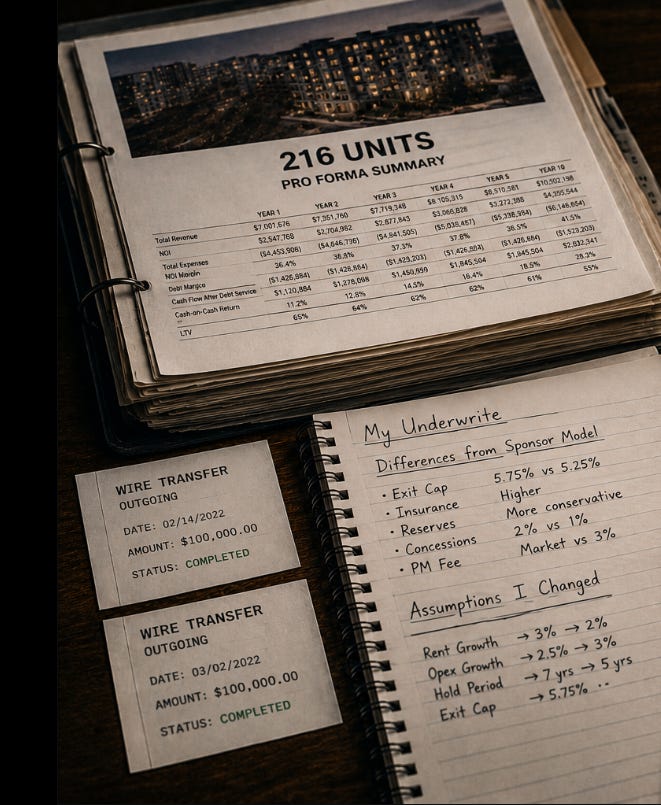
This deal went from 92% occupancy at closing to 54% occupancy.
I personally researched the market and underwrote the deal multiple times. I spent over a year just listening to the sponsor on various podcasts and social media platforms to get a feel for who they were as people.
Before I wired any money, I needed to meet them face to face and see what they were all about. I had been burnt before by so-called “Real Estate Gurus,” so I went to a mastermind they were hosting. I got to meet them, I got to understand their investment thesis, and I was able to look them in the eyes and tell what kind of people they were.
The Deal
216 units, Class A
Projected 5% cash-on-cash returns
18% IRR
2.2x equity multiple over a 10-year hold
Strong market: Ford was building the largest EV battery manufacturing plant in the world
Anticipated population growth of 4% year over year for the next 5 years
8,000+ overall new jobs
Millions in new construction for a new hospital wing
Millions more for a distillery and brewery
What I Accepted
I researched the market myself, verified the legitimacy of what the sponsor was saying, and I actually underwrote the deal at better returns. I created my own market analysis model and my own underwriting model. Everything I saw suggested the returns would be closer to 7% cash-on-cash and a 3x multiple if all things went as planned — and if things took a downturn, I had 4% cash-on-cash and a 2x multiple over a 10-year hold.
Wiring the Money
The last thing I needed to know was whether the sponsors were putting their own money in the deal. They put in over $2 million of their own cash, and I saw that their family was also investing in the deal. If the family was investing, they must believe in this deal.
I looked over the market again, looked over the numbers one more time, and decided to tap into my retirement account — and instead of investing the minimum $100K, I doubled it. I put $200K of my own money in because I believed in the team, I believed in the research, and I believed in the property.
I believed so much that I started talking about it to family, friends, and everyone I knew, and as a member of the sponsor’s educational academy I was given the opportunity to raise money for the deal. I put my $200K in before asking anyone for a dime. Two $100K wires followed — one from a jiu-jitsu training partner, one from a fellow MBA colleague. They saw what I was doing and followed my work.
It was truly humbling, and a great honor, that they would trust me with their money — that they believed enough in my judgment and work ethic to follow me into this deal. It was also a great responsibility.
What Broke
Then the election changed the political landscape — and with it, the EV mandates.
The plant anchoring this market had been producing EV batteries since 2025. In December 2025, Ford and its partner announced the plant would close in February 2026, laying off roughly 1,500 workers, after declining EV sales and changes to U.S. tax credit policy.
There is a next chapter: Ford has since confirmed it will retool the site for energy-storage battery production under its new energy business — an announced $2 billion investment targeting production by late 2027, with about 2,100 full-time jobs. Good news. But a deal underwritten in 2023 doesn’t get to wait for 2027.
This was the line item no rent roll could have foreseen: political shifts, tax-credit changes, and employer concentration risk landing at the same time. I had checked the other employers. I had seen the additional money coming into the area. My underwriting was correct — the rents, the expenses, the debt all held up. What was incomplete was my map of what could break from outside the model.
What an Underperforming Deal Correctly Looks Like
Reserves held
No capital call
Partial distributions continued
~$150K in annual savings after a tax reassessment
Refinance still ahead
The sponsor is projecting 80% occupancy by the end of August
The sponsorship team has worked very hard, and they were smart to hold reserves in the event something unexpected happened. They also locked in a very good, fixed interest rate, which helps substantially. Their work ethic, and the relationships they’ve built over the past year, have helped bring occupancy back to respectable levels.
I have seen great sponsors — and I have friends who invested with other sponsorship teams and lost everything. It’s very important that you know who you’re putting your money with, and that you educate yourself on the process.
What I Check First Now
The first thing I do now, whenever a sponsor approaches me, is ask one simple question:
What is your break-even occupancy?
Then I ask these follow-up questions:
What does your business plan look like if occupancy drops to 50%?
How long can you maintain 50% occupancy before a capital call?
How much in reserves are you planning to hold?
What is your plan to bring occupancy back to 80% or more?
Can you provide me with the rent roll, T12, and OM, and let me underwrite the deal myself?
If they are not willing to give you the financials, or if they don’t have good answers to the questions above — walk away. The first rule of investing is preserving your capital. If they give you the financials and have good answers, then really evaluate the market. Ask yourself:
Who are the employers?
What percentage of local employment does any one employer represent?
What is the concentration risk?
How is the population growing?
What is the crime rate like?
There is much more to look at, but that is a very good start — a real foundation on the deal.
Remember always: “You can underwrite a deal correctly and still get blindsided, because the thing that breaks aren’t in the model.”
Contact Information
Who am I?
I have been in Information Technology for over 25 years at various roles from Systems Engineering to Director lever positions. I have also been in real estate since 2019 focusing on fix and flips and in 2023 we shifted our focus to commercial real estate investing. I have acquired 246 units and continue to pursue real estate investments. I also have a Technology Firm helping companies incorporate technology, build systems integrations, and solve complex business problems with technology solutions. An example of this was our Multifamily Deal Evaluator application that was built with an operator, syndicator, and investor perspective so that anyone can learn to underwrite, analyze, and evaluate deals. If you are interested in the tool, you can check it out at KeptDo MFA PRO. If you like to learn more about what we do with technology, please visit our site Del Val Investment Group.
Outside of my family, my dog, and my Miami Hurricanes my passion is business, technology, and real estate. We are always looking to purchase businesses that have a unique niche and serve our vision of solving real world business problems with technology and we are always looking for real estate opportunities we can operate or invest in as joint partners that we can bring to our investors.
If you would like to reach out or learn more about my background, feel free to connect with me on the following platforms.

Manny Del Val | CEO and Founder Del Val Investment Group