


Dear Friends,
I keep seeing businesses talking about AI.
AI agents. AI automation. AI-powered customer service. AI-powered sales. The list goes on.
But I have a question.
How much of this technology is actually improving the bottom line?
In 2025, MIT Project NANDA released a report called The GenAI Divide: State of AI in Business 2025. The preliminary research found that 95% of organizations studied weren’t seeing measurable profit-and-loss returns from their generative AI investments. Only about 5% of integrated pilots were extracting substantial value.
That doesn’t mean 95% of every type of AI project fails. But it raises a serious question about how businesses are implementing this technology.
I believe a big part of the problem starts before anyone writes a line of code, purchases software, or hires an AI consultant.
Business owners are trying to implement AI without fully understanding the processes they’re trying to improve.
And that’s where I believe they’re making their first mistake.
Before You Automate Anything, Understand What You’re Doing Today
I’ve spent more than 25 years working in technology, and one thing I’ve learned is that technology alone doesn’t solve business problems.
You need to understand the business first.
What are you trying to accomplish?
What does your current process look like?
Where does that process break?
What’s slowing your employees down?
What would success actually look like?
These might seem like basic questions, but they’re critical.
If you don’t understand your existing workflow, how can you determine whether AI is the right solution?
You could spend $25,000 implementing a new automation system only to discover that the underlying problem was never addressed.
Maybe your issue isn’t that your employees take too long to respond to customers. Maybe it’s that incoming requests aren’t being routed to the right people.
Maybe you don’t need an AI sales agent. Maybe you need to understand why qualified leads aren’t converting.
Maybe you don’t need AI to review hundreds of documents. Maybe you first need to standardize how those documents are collected and evaluated.
Automating a process you don’t understand doesn’t necessarily make your business better. It might just allow you to execute a flawed process faster.
A Real Example From Commercial Multifamily Real Estate
Let me share an example from a commercial multifamily real estate consulting engagement.
Our objective was to improve how we evaluated investment opportunities and determined whether to move forward with a letter of intent.
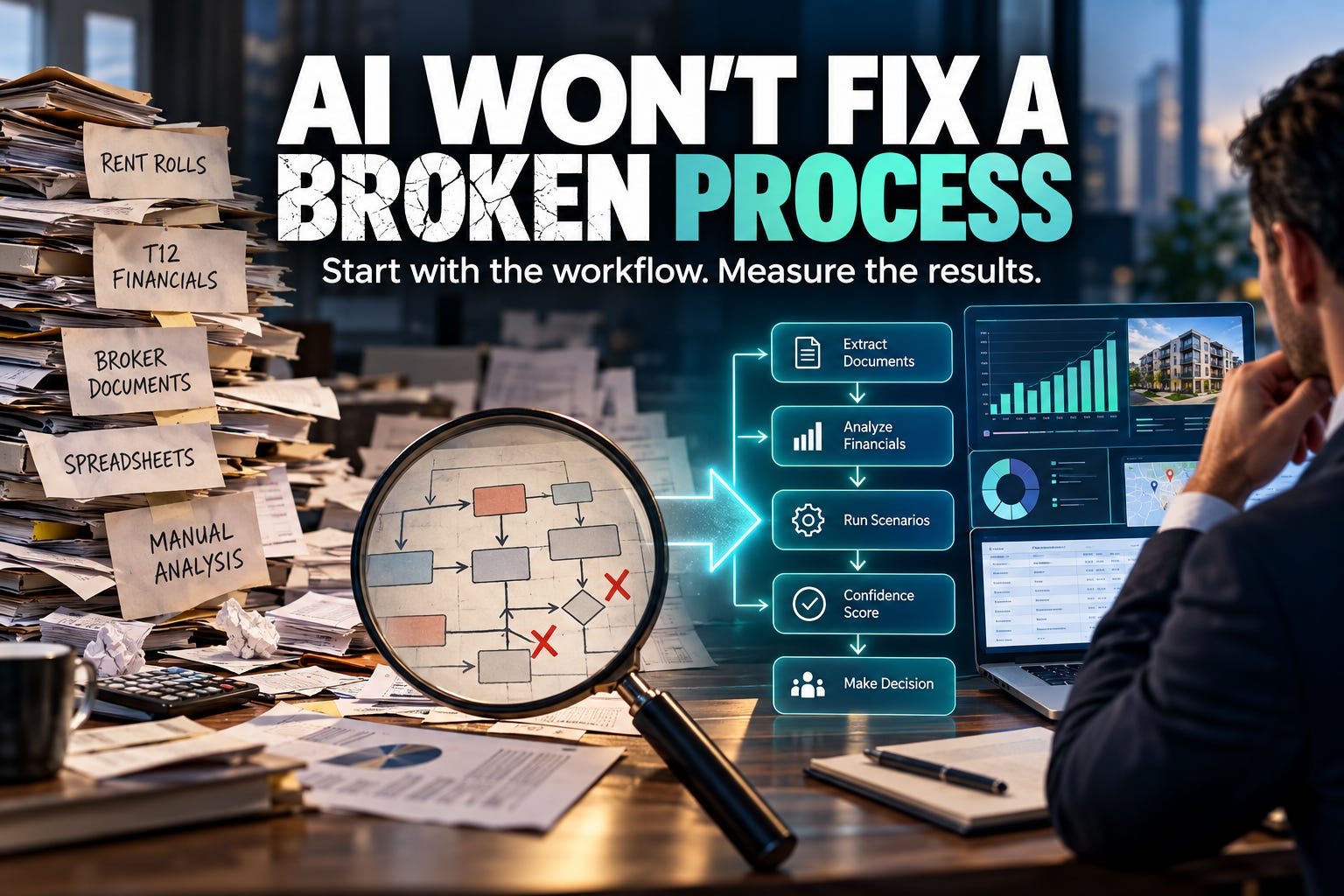
Before implementing AI, we took the time to understand the entire deal-analysis process.
We mapped everything.
How did we receive documents from brokers?
How did we review rent rolls and trailing twelve-month financial statements, commonly called T12s?
What did our underwriting process look like?
What key performance indicators were we evaluating?
How did we assess the market?
How were we structuring the capital stack?
What assumptions were we making?
How long did it take us to make a yes-or-no decision?
More importantly, what were we waiting on before we could move forward?
We wanted to understand every step, how those steps interacted, and where the bottlenecks existed.
Only after completing that assessment did we start designing the AI workflows and developing the SaaS application.
The results
Before implementing the application, evaluating a deal took approximately 40 hours.
Today, that process takes approximately 10 hours. That’s a 75% reduction in analysis time but the time savings weren’t the most important benefit.
We were able to increase our deal-intake capacity by approximately three times.
That matters in commercial real estate acquisitions because evaluating opportunities is a volume-driven activity. The more quality opportunities you can evaluate efficiently, the more opportunities you have to submit competitive LOIs and potentially close acquisitions.
We also reduced our dependency on any one individual to complete the underwriting process.
Tasks such as parsing rent rolls, extracting financial information, and organizing broker documentation could be handled through the application rather than requiring the same repetitive manual work.
But we didn’t stop there.
We built a confidence-scoring component into the tool that evaluates our underwriting assumptions against market dynamics.
That helps us identify assumptions that might be too aggressive or that require further investigation.
It provides information to support the decision, rather than simply generating an answer.
AI doesn’t make the final investment decision. We do.
And that’s exactly how I want it.
The application helps turn data into usable information faster, so we can spend more time evaluating the opportunity and less time preparing the information.
There is an important distinction here, however. We measured faster analysis and increased capacity. That doesn’t automatically mean three times as many acquisitions closed or three times the profit.
Those outcomes require separate measurement.
What Most People Don’t See: The Three Months Behind the Results
Here’s the part that often gets left out of the AI success stories.
It took approximately three months to assess the workflows, develop the application, and refine it.
During that period, we had to adjust calculations, correct code, and address security requirements.
We’re talking about technology being used to help analyze multimillion-dollar investment opportunities.
The financial calculations need to be accurate.
The information needs to be handled securely.
And the people using the application need to understand what it’s doing and how to interpret the results.
Getting AI to produce an answer is one thing. Building a dependable business application around it is something entirely different.
This is why I believe businesses need to move away from looking at AI as a collection of impressive tools and start evaluating it as part of their overall operations.
The Three Pillars I Use When Evaluating AI Opportunities
When I look at a business, I generally break opportunities for improvement into three categories.
I use these same pillars in my work at Del Val Investment Group.
Pillar 1: Get More Customers
How can the business generate more qualified leads and convert more of those opportunities into paying customers?
Could AI help identify potential customers?
Could it improve lead qualification?
Could it shorten response times or make follow-up more consistent?
But remember, the goal isn’t to send more automated messages. The goal is to acquire more customers profitably.
Measure qualified leads, conversion rates, customer acquisition costs, and new revenue.
Pillar 2: Make Each Customer Worth More
Businesses sometimes spend so much effort pursuing new customers that they overlook opportunities within their existing customer base.
Do you understand your customer personas?
Do you understand your pricing?
Are there additional services your existing customers could benefit from?
Could AI help identify purchasing patterns, improve pricing analysis, or identify relevant cross-selling opportunities?
Here, I would look at revenue per customer, retention, additional services purchased, and customer profitability.
Pillar 3: Spend Less to Serve Each Customer
This is where our multifamily example fits.
What tasks are repetitive?
Where are employees spending unnecessary time?
How long does it take to reach a decision?
Can you streamline document processing, eliminate duplicate work, reduce errors, or deliver a better customer experience?
The objective isn’t simply to cut expenses. It’s to help the business produce better outcomes with less time and unnecessary effort.
The three pillars provide a starting point.
Once you’ve identified the objective, then you can evaluate the workflows that contribute to it.
Your Employees Need to Be Part of the Process
Another mistake I see businesses risk making is focusing entirely on the technology and overlooking the people who will actually use it.
You need employee buy-in and I believe that starts by answering two very simple questions.
Why are we doing this?
How is this going to benefit me?
If employees believe AI is simply being implemented to eliminate their positions, why would they be excited about helping you implement it?
But what if you explain that you’re trying to automate repetitive work so they have more time for the responsibilities that require their expertise?
What if instead of spending hours collecting information, they can review it, validate it, and approve the next step?
What if the technology helps them serve customers better and reduces the frustration of manual tasks?
That’s a different conversation.
Employees often know where the real process problems exist because they’re dealing with them every day.
Involve them in the assessment.
Ask what slows them down.
Ask which tasks they wish they didn’t have to repeat.
Their input can help you identify where improvements are actually needed.
A Word About AI Consultants
I work in technology and develop AI solutions, so I understand the excitement around what these tools can accomplish but I also believe consultants have a responsibility to understand the business before proposing a solution.
If you’re hiring an AI consulting firm, one of the first things it should help you do is assess your workflow.
What does the business want to accomplish?
What does the process look like today?
Where are the bottlenecks?
What systems and data are involved?
What needs to be secured?
How will success be measured?
What will it cost to implement and maintain the solution?
If a consultant starts recommending tools without understanding your business or establishing success criteria, I would question that approach.
In my view, they’re doing you a disservice.
Whether you build internally or hire an outside firm depends on your technical capabilities, the complexity of the work, and the economics of the solution.
Having the expertise to build something doesn’t automatically mean you should build it, but either way, the business assessment needs to come first.
How Do You Know Whether the Investment Worked?
Suppose you spend $25,000 implementing an AI workflow.
Ninety days later, what would make you say the investment was worthwhile?
The answer depends on what you were trying to improve.
Did your team get to decisions faster?
Did you generate more qualified leads?
Did revenue increase?
Did the cost to serve customers decline?
Are your employees able to complete more meaningful work?
Are your customers happier with their experience?
These are the kinds of outcomes I would want to evaluate, and I’d want to measure them against a baseline established before implementation.
If the objective was reducing service costs, simply making the process faster may not be sufficient. You need to determine whether the saved time reduced actual costs or allowed the business to handle more work.
If the objective was lead generation, more leads alone aren’t enough. You need to know whether they’re converting into profitable customers.
An AI project shouldn’t be judged by how impressive the technology looks. It should be judged by whether it accomplished the business objective.
Where I Would Tell a Business Owner to Start
If you’re a business owner wondering whether AI could help you, here’s where I would begin.
First, identify which of the three pillars matters most to your business right now.
Do you need more customers?
Do you need to increase the value of each customer relationship?
Do you need to improve efficiency and reduce your cost to serve them?
Next, identify one workflow that’s painful, inefficient, or broken.
Not ten workflows. One.
Understand exactly what happens from beginning to end.
Who is involved?
What information is needed?
Where does the process get stuck?
What is the impact on the business?
Then determine what improvement would mean financially and operationally.
Only after understanding those things would I evaluate the technology.
You might decide AI is the right solution.
You might discover that an existing software platform can solve the problem.
Or you might find that improving the process itself provides most of the benefit without introducing AI at all.
All three can be good outcomes.
My Final Thought
I believe AI has tremendous potential to improve how businesses operate.
I’ve experienced it firsthand.
We’ve reduced a roughly 40-hour deal-analysis process to approximately 10 hours and increased our capacity to evaluate investment opportunities.
Those results didn’t happen because we purchased an AI tool and hoped it would fix everything. They came from taking the time to understand the business, assess the critical workflows, identify the problems, and build technology around the actual needs. They required months of development and refinement.
Not every business needs AI. Not every business is ready for it, but I believe every business owner should at least understand where the opportunities and gaps exist.
If you’re considering an AI investment, my advice is simple:
Understand your business first. Understand your processes second. Define success before you build.
And if you’re paying a consultant to help you, make sure they’re willing to do the work necessary to understand your business before recommending a solution.
The goal was never to implement AI. The goal was to build a better business.
Taking It Apart
This is me Taking It Apart if you found this valuable, I humbly ask for you to subscribe and share the newsletter with others whom you think will find value.
Contact Information
Who am I?
I have been in Information Technology for over 25 years at various roles from Systems Engineering to Director level positions. I have also been in real estate since 2019 focusing on fix and flips and in 2023 we shifted our focus to commercial real estate investing. I have acquired 246 units and continue to pursue real estate investments. I also have a Technology Firm helping companies incorporate technology, build systems integrations, and solve complex business problems, An example of this was our Multifamily Deal Evaluator application that was built with an operator, syndicator, and investor perspective so that anyone can learn to underwrite, analyze, and evaluate deals. If you are interested in the tool, you can check it out at KeptDo MFA PRO.
If you like to learn more about what we do to help small and mid-size businesses get more customers, make each customer worth more, and spend less to service them please visit Del Val Investment Group.
We are also looking to purchase cash flowing online virtual businesses or businesses in Central Florida. We are looking for business that have been in existence for at least 5 years, have a least $1 Million in revenue, and have an established sales process. If you are looking to sell your business and it meets these criteria I would like to talk to you.
Outside of my family, my dog, and my Miami Hurricanes my passion is business, technology, and real estate. We are always looking to purchase businesses that have a unique niche and serve our vision of solving real world business problems with technology and we are always looking for JV real estate opportunities we can operate or invest in as joint partners.
If you would like to reach out or learn more about my background, or if you have a business, you are looking at selling or looking for a partner, or if you want to invest with us feel free to connect with me on the following platforms.

Manny Del Val | CEO and Founder Del Val Investment Group
Personal LinkedIn | Business LinkedIn | Facebook | Email
Taking It Apart explores what works, what doesn’t, and what we can learn from building, buying, investing in, and operating businesses.
Research reference: MIT Project NANDA, The GenAI Divide: State of AI in Business 2025. Preliminary research conducted January–June 2025; its findings should not be interpreted as a universal failure rate across all AI projects.