


Dear Friends,
I remember when it came time to send the money.
$225,000.
This wasn’t money I had sitting around that I didn’t care about. This was hard-earned retirement money that came from years of working, saving, investing, doing fix and flips, and buying smaller residential multifamily properties.
It was also the largest investment I had ever made where I wasn’t the one in control.
That part bothered me. I like to be in control and was not used to leaving that to someone else.
When you own the property yourself, you can make decisions. You can change contractors. You can change property managers. You can refinance. You can sell. You can change the plan.
As a passive investor, once that wire goes out, someone else is making most of those decisions.
I would be lying if I said I wasn’t nervous.
I went back and forth before sending the money.
In the end, I sent $200,000 into a Class A multifamily property in Kentucky and another $25,000 into a townhome project in Tennessee.
I didn’t send it because I thought nothing could go wrong.
I sent it because I had spent a lot of time doing my homework and believed I understood the operator, the markets, the properties, the debt, and the risks.
A lot of that due diligence turned out to be right.
There was also one major thing I didn’t look at closely enough.
That one lesson has probably changed the way I invest more than anything else.
It Started with a Guy Who Kept Showing Up on YouTube
At the time I was doing fix and flips and investing in smaller residential multifamily properties, but I really wanted to understand commercial multifamily.
This guy named Carlos Salguero kept showing up in my YouTube feed.
I ignored him for a while.
Eventually I decided to listen to his podcast.
His story caught my attention. He came to the United States when he was young, became an engineer, worked in IT, got laid off, started his own company, sold it, and eventually got into commercial multifamily.
There were parts of his story I could relate to, especially coming from an IT background myself.
But his story wasn’t enough for me to invest with him.
Actually, I was pretty skeptical.
There are a lot of people in real estate selling courses, masterminds, coaching programs, and the dream of financial freedom. Some are very good. Some are not.
Carlos was selling education too, so immediately my radar went up.
Instead of assuming what he was telling people was true, I started checking.
If he talked about population growth in a market, I researched the population growth.
If he talked about job growth, I looked at the jobs.
If he talked about a market he liked, I started researching that market myself.
If he made a statement about how commercial multifamily worked, I went out and tried to verify it.
I didn’t agree with everything he said either.
There were markets he was more bullish on than I was. There were things where I came to a different conclusion.
That was okay.
What mattered to me was that the fundamental concepts he was teaching about commercial multifamily made sense, and when I checked the statistics and market information he talked about, most of what I was checking was accurate.
I followed him for about a year before I invested anything with him.
Looking back, that was probably my first step in due diligence before I even realized I had created a process.
I wasn’t just listening to what he said.
I was asking myself:
Can I independently verify this?
That is a very different question.
Eventually I Decided I Needed to Meet Him
After following Carlos for a while, he had an investment coming up in Tennessee that caught my attention.
He also had a three-day mastermind where he taught people the basics of commercial multifamily and showed the group the actual property his team was investing in.
I decided to go.
Part of the reason was education.
The other part was that I wanted to see for myself what this guy and his team were really about.
There is only so much you can learn about someone from YouTube.
I wanted to sit in the room.
I wanted to see how Carlos interacted with people.
I wanted to see how his team operated.
I wanted to understand how they looked at markets, how they looked at deals, how they underwrote properties, and how they answered questions when somebody pushed back.
I was specifically looking for the guru stuff.
Big promises.
Everything is great.
Real estate always goes up.
Anybody can do this.
Buy my program and you will be financially free.
That type of thing.
There was an upsell into his academy, so let’s be clear about that.
But the three days themselves felt genuine to me.
They showed us the property. They talked about how they structured deals. They discussed problems they had dealt with. They showed how they looked at underwriting and how somebody could actually learn to do this themselves.
I walked away feeling like there was something here I wanted to understand at a much deeper level.
I have a saying:
You pay to learn, or you learn to pay.
Sometimes you pay somebody to teach you.
Sometimes you don’t, and you end up paying a lot more for the mistakes you make because you didn’t know what you were doing.
I decided to join the academy.
I became especially focused on the financial and underwriting side of the business.
One of the biggest lessons I learned during that time was that commercial multifamily is a team sport.
You cannot do everything yourself.
I was eventually asked to join the Level 7 team a team formed by Academy students and spent about two years with them. Later I decided to go in a different direction and partner with a team that had significantly more experience in real estate, where I could concentrate on the two areas I felt I brought the most value to, technology and financing.
But before all of that happened, I had to answer the biggest question.
Was I willing to put my own money into these deals?
And not a little money. A lot of money.
The 7 Things I Looked at Before Sending $225,000
Over time I developed a process for deciding whether I was comfortable investing with an operator.
It wasn’t perfect.
I know that now.
But I still believe most of it was right.
1. Find Out Who the Operator Really Is
Before I start getting excited about an IRR or equity multiple, I want to know who is going to be controlling the investment.
Who is this person really?
How do they act when you are sitting across the table from them?
Will they answer difficult questions?
How do they treat the people on their team?
How does the team function together?
Whenever possible, I strongly believe you should meet the person you are considering giving your money to.
Face to face.
I understand that isn’t always possible. A Zoom or Teams meeting can bridge the gap.
But if you are serious about investing a significant amount of money with someone, go to an investor meetup. Go to an event. If they have a mastermind or some other opportunity where you can interact with them directly, use it.
It is much harder for somebody to hide who they are when you are sitting directly across from them asking questions.
And this is simple for me.
If somebody wants a significant amount of my money but is unwilling to make themselves available to me, I have a problem with that.
2. Understand Their Values and How They Make Decisions
I don’t think looking at somebody’s resume is enough.
I want to know how they think.
What do they value?
Do those values align with mine?
How do they make decisions?
How do they talk about risk?
Are they always telling you how great the deal is, or are they willing to tell you what could go wrong?
Everybody looks smart when everything is going well.
I wanted to understand how Carlos and his team would behave when something didn’t go according to plan.
At the time I was trying to figure that out from watching them.
Later I would get the opportunity to see it firsthand.
3. Analyze the Market Looking for Reasons NOT to Invest
This has become one of the biggest parts of the way I look at investments.
When we like a deal, we naturally start looking for information that proves we are right.
That is dangerous.
I want to do the opposite.
Tell me why I shouldn’t invest.
What is wrong with this market?
Where are the weaknesses?
Are jobs actually growing?
Is the population really growing?
Who are the employers?
Are those employers expanding or contracting?
Is new supply coming?
Why could renters leave?
What happens if my rent-growth assumption is wrong?
I would rather kill my own deal before I invest than have the market kill it for me afterward.
4. Understand the Debt
You can buy a good property and still have a bad investment because of the debt.
What are the loan terms?
Is the rate fixed or floating?
When does the debt mature?
What assumptions are being made around refinancing?
What happens if interest rates are higher than expected?
What happens if occupancy takes longer to stabilize?
What happens if the refinance that looks obvious today isn’t available two years from now?
Debt can give you leverage on the way up.
It can also put you in a very bad position when things don’t go according to plan.
5. Verify the Operator’s Track Record
I didn’t just want to hear, “We’ve been in real estate for X number of years.”
Show me the deals.
Have you managed something like this before?
Have you managed properties of this size?
Have you invested in markets like this?
What happened?
Where did things go right?
Where did they go wrong?
What did you learn?
Experience is important, but relevant experience is even more important.
6. Ask a Lot of Questions About Risk and Operations
Property management.
Asset management.
Occupancy.
Expenses.
Reserves.
Unexpected repairs.
Leasing.
Debt.
I wanted to understand what happened when something went wrong.
Because something always goes wrong.
Maybe it is small.
Maybe it is big.
But I have never seen a business plan where everything happens exactly according to the spreadsheet.
The question isn’t whether problems will happen.
The question is whether the operator, the property, and the capital structure can handle them.
7. Get the Financials and Underwrite the Property Yourself
This is a big one for me.
Don’t just look at the beautiful investor presentation.
Give me the financials.
I want to underwrite the deal myself.
I want my own assumptions on rents.
My own assumptions on expenses.
My own thoughts on vacancy.
My own market analysis.
Then I want to compare my numbers with the operator’s numbers.
Where are we different?
Why are we different?
Are their assumptions reasonable?
Or are they using pie-in-the-sky economics to make the deal look better than it really is?
At some point you have to separate the sales presentation from the property.
The numbers should be able to stand on their own.
Why I Put $200,000 Into Kentucky and Only $25,000 Into Tennessee
I want to make something clear.
I did not have the same conviction in both investments.
The Kentucky property was a Class A property in an area where I believed there was a tremendous amount of economic development happening.
I invested $200,000.
The property was relatively new, which meant I wasn’t expecting a tremendous amount of capital expenditures right away.
I liked the area.
The rents looked a little low to me, which suggested there was room for growth.
The underwriting was projecting rent growth of roughly 2.5% to 3%, and based on the research I was doing at the time, I didn’t think that was unreasonable.
I was actually a little more conservative on expenses than the operator, but I was more bullish on the market and on the opportunity to grow rents.
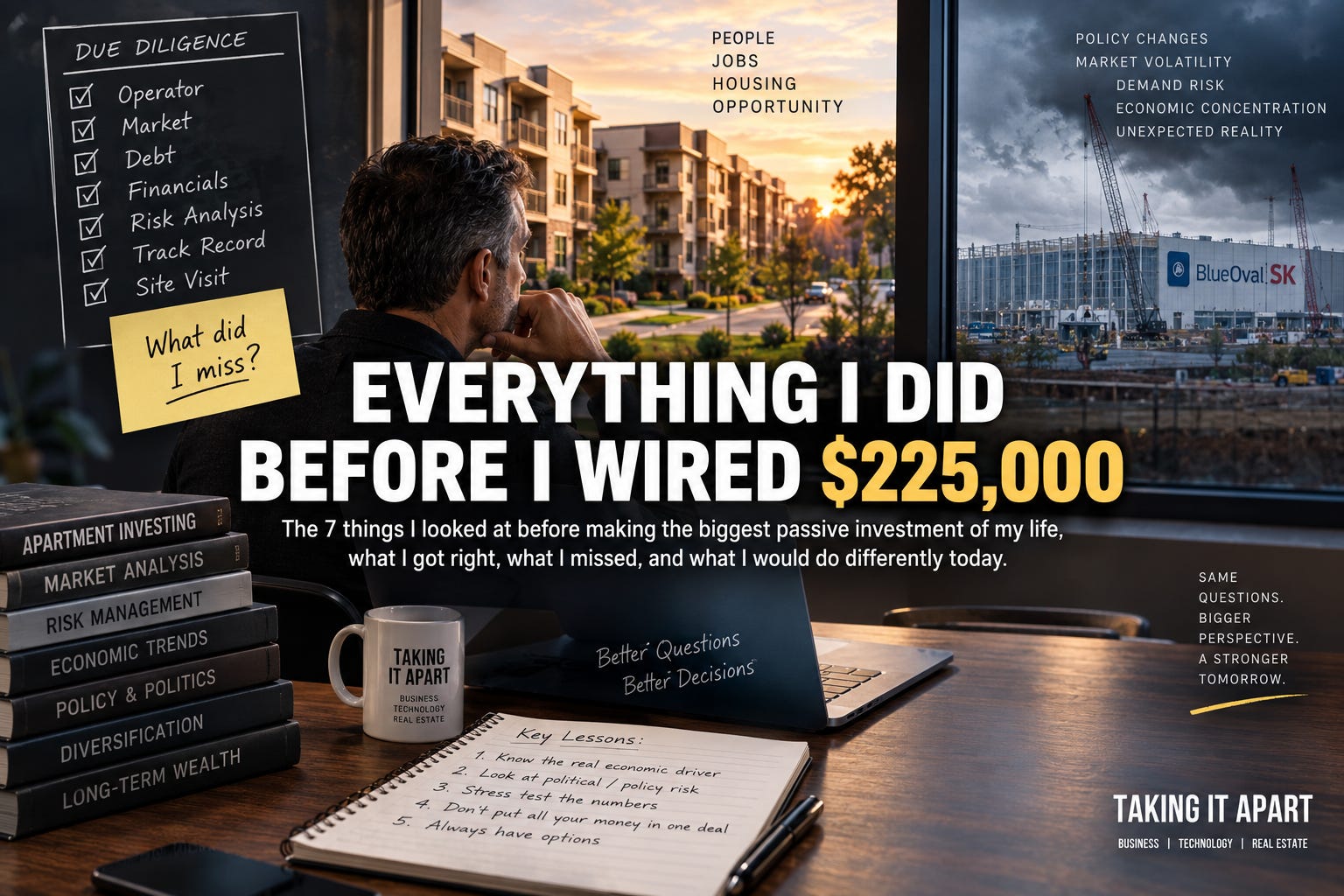
One major part of the economic story was the BlueOval SK battery development in Kentucky.
When Ford and SK originally announced the project, the Kentucky battery park was expected to represent about $5.8 billion in investment and approximately 5,000 jobs. That was a huge economic development story for the area.
The Tennessee deal was different.
I invested $25,000 there.
It was a secondary market roughly an hour outside Nashville, and I wasn’t nearly as bullish on the local economics.
The townhomes were brand new, which I liked because I expected relatively little capital expenditure.
But it was a lease-up.
I knew going in that it could take time to reach the occupancy needed to start distributions.
I also knew the plan included refinancing later into better debt terms.
I wasn’t crazy about the idea that I might go a year without distributions.
But it was a $25,000 investment rather than $200,000.
That was part of my risk decision.
I had more conviction in one deal, so I put more money into it.
At the time that made complete sense to me.
Today I would handle that differently.
The Risk I Did Not Spend Enough Time On
This is probably the biggest lesson from the entire investment.
We looked at the population.
We looked at job growth.
We looked at rent growth.
We looked at debt.
We looked at the property.
We looked at the operator.
I underwrote the numbers myself.
What I did not do well enough was ask:
What is really driving the economics of this market, and how dependent is the entire thesis on that one thing continuing to happen?
That is a different level of market analysis.
The Kentucky story had a major connection to electric vehicle and battery manufacturing.
In December 2024, the Department of Energy closed a loan of up to $9.63 billion to BlueOval SK for battery manufacturing facilities in Kentucky and Tennessee.
Then the environment changed.
The 2024 election was followed by major changes in federal EV policy. At the same time, EV demand, economics, and automaker strategies were changing too. Federal EV tax credits were ended earlier than previously planned, other EV policies were rolled back, and Ford later made major changes to its own EV and battery strategy.
I don’t think it would be accurate to say one election by itself caused everything that happened. There were multiple factors.
But from my perspective as an investor, I had not put enough weight on the fact that government policy and one large industrial project were such important parts of the local economic thesis.
That was the mistake.
The Kentucky property’s occupancy was around 92% when it was purchased.
At its lowest point, it fell to roughly 54%.
That gets your attention really fast.
I had studied the economic engine.
I had not done enough work around what happens if the engine stalls.
Today There Is an Eighth Step
If I were writing my due diligence checklist today, I would add an eighth step.
8. Understand What Is Really Driving the Local Economy and What Happens If It Changes
Today I want to understand every major source of employment in the area.
Who are the biggest employers?
What industries are driving job growth?
How diversified is the economy?
Is the market depending too heavily on one company?
One plant?
One industry?
One government program?
One political policy?
One tax incentive?
Then I want to take it further.
What happens if that main economic driver goes away?
What else is there?
Are there other industries that can pick up the slack?
Is the market big enough and diversified enough to absorb the loss?
And one of the questions I think people miss is this:
How long does that transition take?
People will sometimes say, “Something else will come in.”
Maybe.
But when?
Six months?
Two years?
Five years?
Your mortgage doesn’t stop while you wait for the local economy to reinvent itself.
Neither do taxes, insurance, payroll, utilities, or property-management expenses.
That time factor matters.
I pay much more attention to it today.
Interestingly, My Vetting of the Operator Did Work
This is where investing gets complicated.
The Kentucky deal has not produced the distributions or returns I originally expected so far.
But that doesn’t mean everything about my original analysis was wrong.
One of the things I feel I got right was vetting the operator.
When occupancy dropped and the property was struggling, Carlos was upfront about what was happening.
He didn’t pretend everything was fine.
He told investors there wouldn’t be distributions.
He explained why there wouldn’t be distributions.
He communicated what occupancy needed to get back to before distributions could realistically resume.
He explained what the team was doing to improve occupancy.
They had reserves built into the deal, which has helped prevent the need for a capital call to this point.
That matters to me.
Would I rather have gotten all the distributions we originally projected?
Of course.
But when things got bad, I learned something about the operator that no podcast, mastermind, spreadsheet, or investor presentation could have shown me.
I got to see how they acted when the deal was under pressure.
To me, that validates an important part of the original vetting process.
Vetting a good operator does not guarantee you a good outcome.
That isn’t how investing works.
What it can do is increase the chance that when something goes wrong, you have people on the other side who will tell you the truth, communicate, and work the problem.
That is a big difference.
You are not just underwriting a property.
You are underwriting the people who will be making decisions when the property doesn’t follow the plan.
Do I Regret Investing the $225,000?
Yes and no.
That is probably the most truthful answer I can give.
I don’t regret the education.
I have learned more by actually living through these investments than I could have learned from almost any course or textbook.
It changed the way I think.
It changed the way I underwrite.
It changed how I think about markets.
It changed how I think about risk.
A lot of what I learned from Carlos’s academy, combined with my experience actually investing in these properties and my 25-plus years working in information technology, eventually went into what I built with KeptDo.
KeptDo is my AI-driven commercial multifamily underwriting and deal-evaluation platform.
I didn’t build it because I thought I had all the answers.
I built it because these experiences showed me how many questions I wasn’t asking.
One of the things I wanted was a better way to look at downside scenarios.
Not just:
“What does the base case say?”
I wanted to understand:
What happens if occupancy falls?
What happens if rent growth isn’t what I expect?
What happens if expenses go up?
Where is break-even occupancy?
How much time does the deal have before cash reserves become a problem?
At what point could a capital call become necessary?
What combination of things can go wrong before the deal breaks?
That is why I built things like Monte Carlo simulations, break-even analysis, sensitivity analysis, and scenario analysis into the platform.
The idea isn’t to predict the future perfectly.
You can’t.
The idea is to understand more of the possible futures before your money is already in the deal.
That came directly from experience.
But there is another side to my answer about regret.
Sometimes I do regret putting that much money into the investments.
Not necessarily because I wouldn’t have invested.
I would have invested less.
If I were making the same decision today, I probably would have put in roughly half the amount.
That would have left me with around another $100,000 available for other investments and other opportunities.
That is the lesson that probably hit me the hardest.
I Learned the Importance of Having Options
There is a school of thought in investing that says to find one thing, get really good at it, and go all in.
I understand the logic.
If you know something really well, why wouldn’t you put your money behind it?
The problem is that no matter how well you understand something, there are still factors you cannot control.
Government policy changes.
Technology changes.
Consumer demand changes.
Interest rates change.
Capital markets change.
A major employer changes direction.
A corporation decides a project isn’t as important as it was three years earlier.
You can be very good at what you do and still get hit by something you didn’t control.
That changed my investment philosophy.
Today I want more options.
I prefer investments where I have more liquidity.
If my money is going to be tied up for ten years, I want considerably more control over what is happening.
If I am investing passively, I would rather see something closer to a five-year hold than a ten-year hold, assuming the deal itself makes sense.
Most importantly, I don’t want all of my investment capital tied to one deal, one market, or one sector.
That doesn’t mean I won’t make a large investment when I have high conviction.
It means I now put a much higher value on diversification and liquidity.
There is a cost to having $200,000 tied up in an investment even if the capital itself is ultimately preserved.
That money can’t go into another opportunity.
That’s opportunity cost.
I understand that much better today than I did when I sent the wire.
What Would I Tell Someone About to Wire $225,000 Today?
First, don’t just ask how much money you can make.
Everyone likes looking at the upside.
Ask what has to remain true for the investment to work.
Then start trying to prove those assumptions wrong.
Who is the operator?
Can you meet them?
What are their values?
How do they make decisions?
What have they actually done before?
How does the debt work?
What happens if occupancy drops?
What happens if expenses rise?
What does the market really look like?
Does your independent underwriting agree with the operator’s underwriting?
What happens if your rent-growth assumptions are wrong?
What is driving the jobs in the area?
How diversified is the economy?
Are government policies supporting any major part of the growth story?
Could those policies change after an election?
If the biggest employer or industry disappears, what replaces it?
How long will that replacement take?
Then I would ask one more question that I didn’t appreciate enough at the time:
How much of your available investment capital are you willing to lock into one outcome?
I did a lot of homework before I wired $225,000.
Most of it helped me.
Some of it turned out to be very important.
I also missed something big.
That is investing.
You can do a tremendous amount of due diligence and still not know everything that is going to happen over the next five or ten years.
The answer isn’t to stop investing.
For me, the answer is to keep getting better at asking questions, build better tools, diversify my risk, and make sure one investment can’t take away all of my other options.
If I could leave someone with one thing before they send a large wire into a passive real estate investment, it would be this:
Make sure you’re confident sending the money. Do your own homework, understand what is really driving the market, and pay attention to political and policy factors that could change the economics of the deal.
And before you hit send, ask yourself one last question:
If I’m wrong, do I still have options?
Call To Offer
If you want to see the tool I build and created for analyzing and underwriting multifamily deals and want to see whether this approach could fit into your own operations or investment strategy you can try Keptdo with a 14-day free trial at
If you rather see how I personally use it, reach out to me. I am happy to schedule a call and a walk-through demo with you.
Because the point isn’t to let AI make your investment decisions, it’s to help make better ones before the opportunity passes you by.
Taking It Apart
This is me Taking It Apart if you found this valuable, I humbly ask for you to subscribe and share the newsletter with others whom you think will find value.
Contact Information
Who am I?
I have been in Information Technology for over 25 years at various roles from Systems Engineering to Director lever positions. I have also been in real estate since 2019 focusing on fix and flips and in 2023 we shifted our focus to commercial real estate investing. I have acquired 246 units and continue to pursue real estate investments. I also have a Technology Firm helping companies incorporate technology, build systems integrations, and solve complex business problems. An example of this was our Multifamily Deal Evaluator application that was built with an operator, syndicator, and investor perspective so that anyone can learn to underwrite, analyze, and evaluate deals. If you are interested in the tool, you can check it out at KeptDo MFA PRO.
If you like to learn more about what we do to help small and mid-size businesses get more customers, make each customer worth more, and spend less to service them please visit Del Val Investment Group.
Outside of my family, my dog, and my Miami Hurricanes my passion is business, technology, and real estate. We are always looking to purchase businesses that have a unique niche and serve our vision of solving real world business problems with technology and we are always looking for JV real estate opportunities we can operate or invest in as joint partners.
If you would like to reach out or learn more about my background, or if you have a business, you are looking at selling or looking for a partner, or if you want to invest with us feel free to connect with me on the following platforms.

Manny Del Val | CEO and Founder Del Val Investment Group
Personal LinkedIn | Business LinkedIn | Facebook | Email