


Dear Friends,
My Condo Has Been a Second Job Since 2023. When I bought my beachfront condo, I thought I understood the risks. I knew short-term rentals could be unpredictable. I knew there would be good tenants and bad tenants. I knew things would break. I knew there would be cleaning issues, maintenance, slower rental periods, and the normal headaches that come with owning an investment property.
What I did not know was how quickly an investment could go from producing income to consuming cash, time, attention, and peace of mind.
Since 2023, my condo has felt like a second job. A job I hate. The only problem is that for more than two years, that second job has not paid me a penny. IT HAS COST ME.
The Investment Was Working
We purchased the condo in 2020 for $225,000. It was almost 1,400 square feet, oceanfront, and on the first floor. When the sea grapes were cut back you could get a view of the ocean.
We bought it during COVID because we wanted a beach property we could enjoy and get away to. At the same time, it worked as an investment.
The HOA required a 30-day minimum rental which made the rental business more difficult than a traditional short-term Airbnb property, but from 2020 through the first half of 2023 we really did not have a major problem finding renters.
We had some great tenants. We had some tenants that were not so great. That was expected. Things broke occasionally. That was to be expected too.
We found a great cleaning crew and, for the most part, the problems that came with operating the property were problems we could manage.
Financially, the property was doing well. During peak season, we could rent the unit for roughly $5,000 to $6,500 a month and during the slower months we typically rented the unit from $3,000 to $4,500 a month. Then the value started climbing.
At its height in 2021, the condo appraised for approximately $605,000. Remember we bought it for $225,000. Our original investment goal was to make about 30%. At $605,000, we had not just hit the goal, we had blown through it. We had won but we did not sell.
We Had The Conversation
Selling was something we considered, we talked about it. By that point, we had moved to a beach town ourselves, so the original reason for buying the property had changed too.
Our beach dreamed had already been fulfilled. We did not need the condo in the same manner anymore, but the Airbnb rental income was still good. The property had gone up significantly in value and we thought:
Why sell it?
Let’s just keep riding it out. It is probably going to go up in value. Looking back, that was a major mistake. We got greedy and lazy. That is not easy to say, but it’s true. We had set an investment goal, we reached it, but we moved the goal post because the investment was doing so well we wanted more.
That decision became one of the biggest investment lessons I have ever learned.
Then Things Started Changing
Towards the middle half of 2023 the economics and management around the property started to change. New Management arrived and with it a 33% increase on the HOA maintenance fees.
At the same time, Airbnb was changing its policies and service fees in ways that did not favor the host and created more work for us to stand out and operate the property. They made managing the property much harder.
It took more management to optimize our listing making sure it was position correctly and operating in the way it needed to. We also had additional property management expenses.
Then the special assessments started and once they started things seemed to spiral. There was another assessment in 2024, but even then, I did not expect what came next.
The Day That Everything Changed
In August of 2024, exactly two years ago the building was deemed unsafe. Everyone was evacuated. That was the exact moment I realized this was no longer the investment I thought I owned.
My first thought was simple:
There goes my revenue stream. The property immediately stopped being an income producing asset and became a cost center and it became another job.
Except this job was now about mitigating risks, protecting the investment, dealing with the association, and trying to figure what the next steps would be.
I realized very quickly that I needed legal counsel. I retained an attorney to help me navigate the process. That alone should tell you how much the investment changed. I had gone from managing Airbnb reservations to managing legal risk.
Owning the Condo Did Not Mean Controlling It
One of the biggest frustrations was how little control I actually had. I was basically at the mercy of the condo association. It took nearly a year to settle on a path to repair the buildings. There was constant back and forth. There were discussions about construction law and FEMA rules. There were multiple estimates for repairs.
At one point, the repair proposal being discussed was $9.3 million. The plan that was eventually selected was $4.3 million. That is a massive difference.
Meanwhile, the owners could not use their units. We could not rent them, we could not generate income, but we still had expenses.
The building repair eventually resulted in another special assessment for more than $67,000 per unit.
At one point, I thought the cleanest solution would be to sell the entire property to a developer and make the headache go away, but this is where the HOA governance becomes very real. Certain decisions required 100% agreement.
Think About That
When do you ever get 100% agreement from people on anything? It is not realistic. So, the next option was to repair the buildings and try to get through it as quickly and cheaply as possible.
I Had To Keep Putting Money Into It
At that point, I had several choices, none of them particularly good.
I did not want my credit ruined.
I also believed that if the buildings were repaired and the property became usable again, there would still be value in the condo
I did not expect the value to return to 2021 numbers, but I do think a reasonable value of somewhere between $300,000 and $350,000 range could eventually be attainable
So, I made the decision to keep funding the property
I was able to use my HELOC to pay the assessments. Think about that situation for a minute. I was borrowing against an asset that was generating no income so that I could continue paying for the asset.
That is very different from the investment I thought I owned.
More Than Two Years Without Rental Income
The building was finally approved as safe again in July of 2026. By then, I had gone two years without being able to generate rental income from the property.
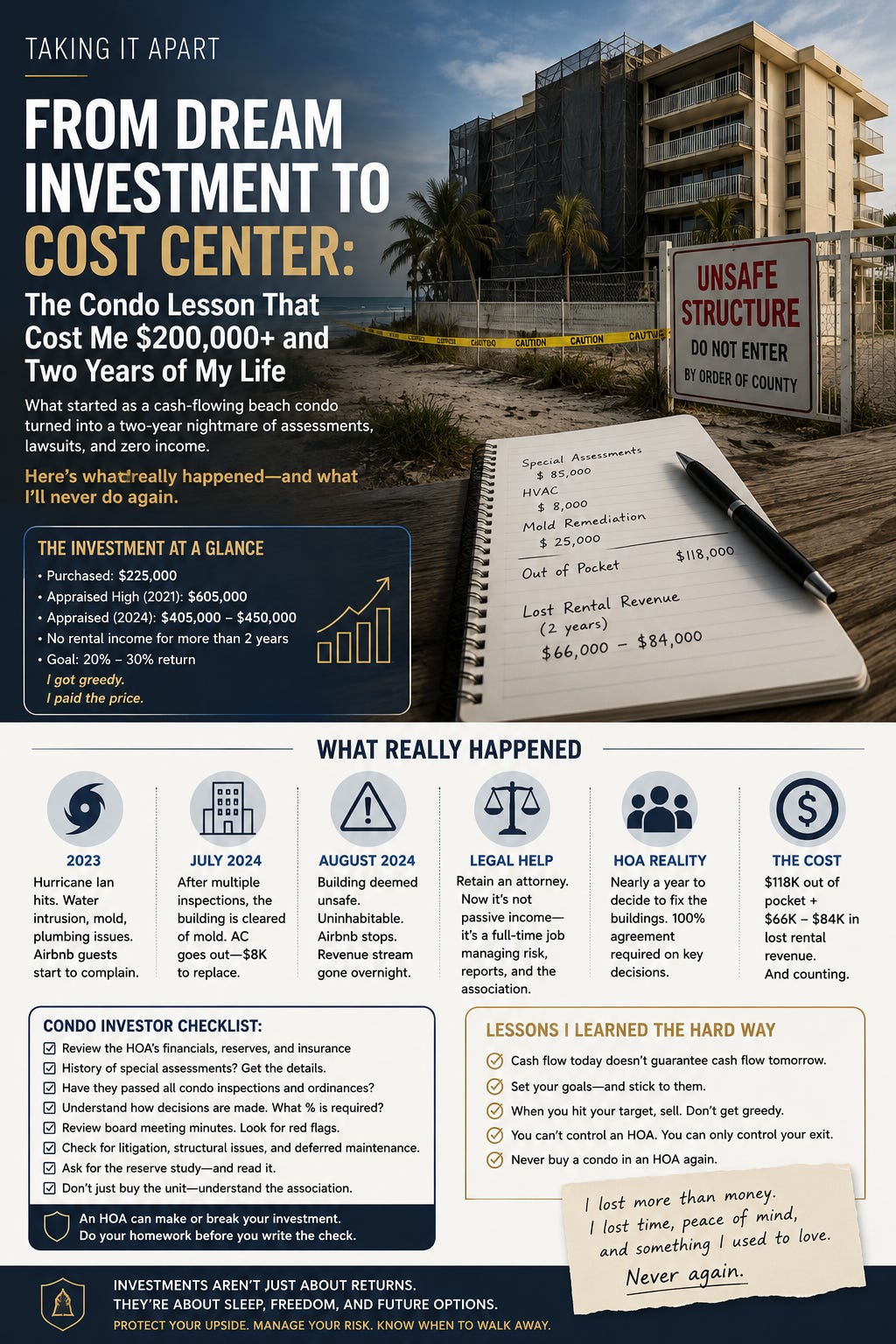
On the low end, I estimate I lost roughly $33,000 per year in gross rental revenue.
On the higher end its closer to $42,000 a per year.
Multiply that by two years and the lost rental revenue is somewhere between $66,000 and $84,000 and that is only the lost revenue. It does not include out of pocket costs.
The Numbers Get Ugly Fast
So far, I estimate that I paid roughly $85,000 in special assessments maybe more. Then I had additional spend of another $8,000 for a new HVAC unit which they broke when the association was moving it.
After finally getting access back to the condo, I found plumbing issues and a leak which I never had before. This leak led to mold, which I am now currently dealing with. The mold damage could be as much as $25,000.
That puts the special assessments and major out of pocket costs at approximately $118,000. Then add another $66,000 to $84,000 in lost gross rental revenue and you are talking about an economic impact between $184,00 and $202,000.
And that still doesnt include everything like:
Attorney Fees
HELOC Interest Payments
HOA Maintenance Cost
Insurance Cost
Travel Cost
My Time
And my mental health
The Cost That Does Not Show Up on the Spreadsheet
This experience has affected me beyond money. I used to love going to this condo. I proposed to my wife there. Now I hate going there. I don’t want anything to do with the place, the neighbors, or the situation around it.
I live two hours away. Now I have to plan trips to just go work on the unit, meet contractors, deal with the insurance company, deal with the HOA, speak with the attorney, and handle the next latest problem.
It is a lot.
That is why I say the condo has become a second job.
Real estate investors spend a lot of time talking about cash flow, appreciation, cap rates, leverage, and return on investment.
We do not spend enough time talking about the value of our time.
Or Stress.
Or Mental Energy.
An investment can cost you more than money.
This one did.
I Will Never Buy Into an HOA Again
This experience has permanently changed the way I look at condos and HOAs. I will never buy another condo. I will never purchase another property with an HOA.
For me it’s not worth it. You can own the unit and still have very little control over the investment.
You are dependent on the financial health of the association and how they manage the property.
You are dependent on decisions by other owners.
You are dependent on the board.
You are dependent on whatever voting requirements are written into the documents.
You may be dependent on 100% agreement to move forward on certain decisions.
And if you can’t get everyone to agree you may be stuck.
If I were choosing between spending more money on a single-family home that was slightly farther away from the beach and buying another condo inside an HOA I would spend more on the single-family home. Think about it $225,000 + another $202,000 in cost not to mention the monthly HOA costs would put me at a single-family home of roughly $427,000 and I control the investment with no HOA approval needed. Sure, it’s a little more upfront but in my opinion well worth it.
CONTROL IS THE SINGLE MOST VALUABLE THING YOU CAN HAVE IN AN INVESTMENT
What Would I Tell Anyone Considering A Beach Condo
If you are thinking about buying a condo on the beach, especially one inside and HOA, be very careful.
Do not only look at the unit.
Do not only look at the rental projections.
You need to understand the association.
You need to know who your neighbors are.
What is the financial condition of the HOA?
How much money does the HOA have in reserves?
What special assessments have already been levied?
What is the process to levy special assessments?
Are there additional assessments being discussed?
What major maintenance has been deferred?
Has the building completed the inspections and requirements applicable in its city and state, and they pass them or fix what needed to be fixed?
How does the association make decision?
What requires a majority vote?
What requires a supermajority?
What requires unanimous approval?
Those questions matter more than the countertops, flooring, ocean view, or bathrooms because you're not just buying a property, you're giving away control and buying into the financial decisions and governance of an association.
The Biggest Lesson Was Not the HOA
As frustrating as the HOA has been, that is not the biggest lesson I learned.
The two biggest lessons I learned are the following and both I could have controlled and done better.
When you are buying a condo, you're giving away control so really know who the association is and how they make decisions.
When you hit your investment goals sell and recoup your capital and proceeds.
I should have sold in 2021 when the property appraised at $605,000. We had accomplished exactly what we originally set out to accomplish. We had another property in a beach town, and we really didn’t need the beach condo. The plans had changed. I should have taken the win.
Instead, I convinced myself that because the property was cash flowing and because values had been rising, I should keep holding it. The conditions changed.
After the Surfside collapse in Miami, the environment around condo ownership changed significantly from my perspective as an owner. By 2024, when I tried to sell, the condo was being valued between $405,000 to $450,000. I had it on the market approximately a month then the buildings were deemed unsafe.
At that point, I did not have the same choices anymore. I had no choice but to ride out the storm as best I could.
What Happens Next
I am still working through this. The building has been approved safe again, but I still have a ton of work left to do. I have to deal with the mold remediation and other work to finish the inside of the condo and get it back to how it was.
My hope is to have the property ready to be rented again by January 2027. At this point I am thinking differently about the rental strategy too. Similar long-term rentals in the area are going for roughly $2,000 to $3,000 per month.
My current thinking is to get the unit fixed, rent it long term for a year or two, continue paying down the mortgage, and eventually sell when the value gets closer to $300,000 to $350,000.
I am not waiting for $605,000 again. I am not trying to squeeze every last possible dollar out of the property. I am trying to get a reasonable exit.
Sometimes that is what investing becomes. Preserver the capital you can, manage the risk, get through the problem, and live to invest another day.
Call To Action
Comment or message me:
I hope you found this valuable. If you are going through something similar, please comment below. I read and reply to every comment.
This is me Taking IT Apart If you found value please subscribe and share below:
Contact Information
Who am I?
I have been in Information Technology for over 25 years at various roles from Systems Engineering to Director lever positions. I have also been in real estate since 2019 focusing on fix and flips and in 2023 we shifted our focus to commercial real estate investing. I have acquired 246 units and continue to pursue real estate investments. I also have a Technology Firm helping companies incorporate technology, build systems integrations, and solve complex business problems. An example of this was our Multifamily Deal Evaluator application that was built with an operator, syndicator, and investor perspective so that anyone can learn to underwrite, analyze, and evaluate deals. If you are interested in the tool, you can check it out at KeptDo MFA PRO.
If you like to learn more about what we do to help small and mid-size businesses get more customers, make each customer worth more, and spend less to service them please visit Del Val Investment Group.
Outside of my family, my dog, and my Miami Hurricanes my passion is business, technology, and real estate. We are always looking to purchase businesses that have a unique niche and serve our vision of solving real world business problems with technology and we are always looking for JV real estate opportunities we can operate or invest in as joint partners.
If you would like to reach out or learn more about my background, feel free to connect with me on the following platforms.

Manny Del Val | CEO and Founder Del Val Investment Group