


Dear Friends
Building KeptDo turned out to be the part I understood. Finding the right people, getting their attention, and convincing them to actually use it has been a completely different challenge.
A few months ago, I had five people sign up for the free trial of KeptDo.
I remember seeing the registrations come through and thinking, Okay, this is good. Now I’m finally going to get some real feedback from people outside my immediate circle.
I figured they would log in, upload a deal, test the underwriting, break something, tell me what they liked, tell me what they hated, and give me some idea of whether what I had built actually made sense to other multifamily operators.
That is not what happened.
They signed up.
And then basically nothing.
No real usage. No feedback. No questions.
I reached out and offered to walk them through the platform.
I followed up more than once.
Nothing.
That was probably the first time I really stopped and thought:
I built this thing. It works. Now how the hell do I sell it?
And that has turned out to be a much harder question than I expected.
I never set out to build a software company
KeptDo did not start with me sitting around trying to think of a SaaS idea.
It started because my team had a problem.
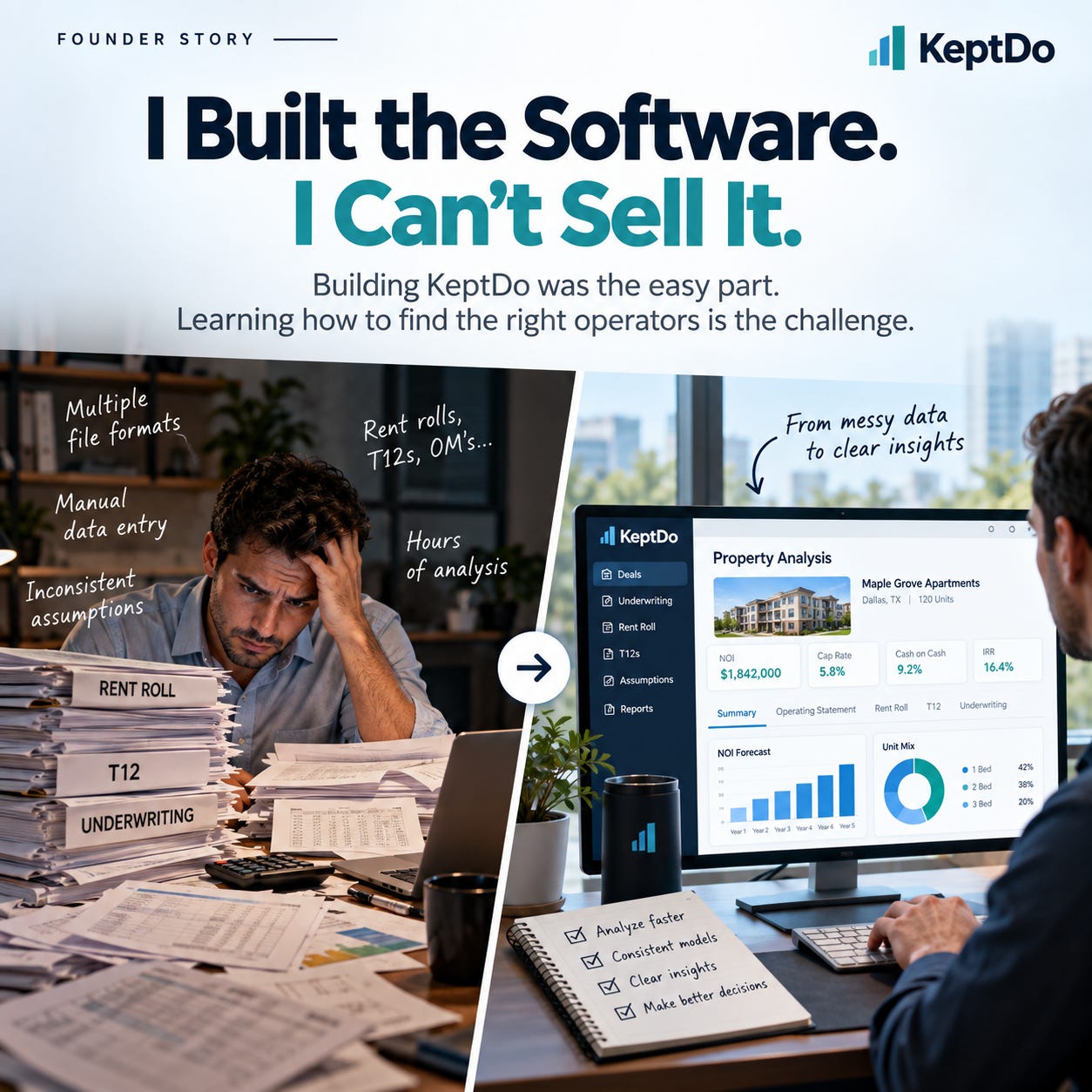
If you have ever underwritten multifamily deals, you know how messy the process can get.
One broker sends a rent roll one way. Another sends it completely differently.
T12s come in different formats.
Offering memorandums have different levels of detail.
Someone has to take all of that information, normalize it, clean it up, fit it into the underwriting model, adjust assumptions, research the market, figure out the capital stack, compare scenarios, and decide whether the deal is even worth pursuing.
Then you still have to organize everything.
Where are we on the deal?
What assumptions did we use?
How does this one compare to the other three deals we are looking at?
What happens if rents do not grow the way we expect?
What happens if expenses come in higher?
What does the capital stack look like?
What is the break-even point?
How confident should we actually be in the assumptions we are making?
We were doing too much of this manually and across too many different places.
So I started building.
Not because I wanted to launch a startup.
Because I wanted to make our own process better.
That became KeptDo
The basic idea was to take what we were already doing and put as much of it as possible into one workflow.
Upload the broker documents. Standardize the data. Underwrite the deal. Change the assumptions. See the deal score change as the assumptions change. Look at the capital stack. Run scenarios. Analyze the market. Run break-even analysis. Compare deals. Track them in a portfolio. Move them through a Kanban board. Generate reports.
Eventually, we added investor journey tools, pitch deck functionality, LOI creation, and other pieces that were already part of the work we were doing.
One of the things I wanted was a confidence rating around the assumptions.
It is one thing to type 4% rent growth into a model.
It is another thing to ask whether the market actually supports it.
The idea was not to replace judgment.
It was to give the operator more information before making the judgment.
That distinction matters to me.
Internally, it worked
This is probably the part that gave me too much confidence.
Our old process could consume around 40 hours of work depending on the deal and how much cleanup was required.
With KeptDo, we were able to compress a big portion of that process dramatically. On cleaner deals, we could get much closer to a decision in a couple of hours instead of spending days moving information around before we could even start thinking about the deal.
That was the validation I cared about.
We were using it. It was saving us time.
It was helping us organize the decision-making process.
So naturally, I started thinking:
If this is helping us, there have to be other operators dealing with the same thing.
And I still believe that.
What I underestimated was everything that happens between having something useful and having someone pay attention to it.
Building the product and selling the product are two completely different jobs
I have more than 25 years in IT.
That background has helped me a lot with AI.
I understand infrastructure.
I understand systems.
I understand how applications fit together.
I have spent a large part of my career solving business problems with technology.
AI gave me the ability to take those skills and build things much faster than I could have before.
That is one of the biggest things I have learned over the last couple of years.
You do not necessarily need a giant development team anymore to take an operational problem and turn it into working software.
You still need to understand the problem.
You still need to know how the pieces fit together.
You still need to build something people can actually use.
But the barrier between idea and working product has changed dramatically.
I felt pretty comfortable in that world. Then I got to sales and marketing.
Completely different story.
The two groups using KeptDo taught me something important
We do have two groups using the platform.
That sounds like validation, and to some extent it is.
But I have to be fair about how those relationships happened.
The first group was already working with me. I was helping them source and analyze deals, so they were using KeptDo as part of that process.
The second group came through a newer partnership where I am also providing underwriting guidance to their team.
Both groups already knew me. There was already trust.
They were not random operators who saw an ad, landed on keptdo.com, entered a credit card, and started using the software.
I was part of the equation. That matters.
Because if this is going to become a real product outside my own relationships, the software has to be able to earn enough trust on its own for someone to try it.
That is the part I have not figured out yet.
I tried the free stuff first
I am not sitting on some huge marketing budget so I did what probably a lot of people would do, I started reaching out on LinkedIn.
I started a connection campaign to connect with more people in multifamily.
I posted about the product. I talked about it on Substack. I posted on Facebook.
I shared it in Facebook groups. I offered a 14-day free trial.
I have videos showing how the product works.
The website tells people what the product is supposed to do.
Still, I have not found a repeatable way to bring the right people into the product.
That is the problem. Not whether I can get a few clicks.
Not whether someone will create an account because they are curious.
Can I consistently get the right operator to say:
This solves a problem I actually have. I want to try it.
I am not there yet.
I think I have been too broad about who this is for
For a while, I would say KeptDo is for multifamily operators. That may technically be true. It is also not very helpful.
A large operator with an acquisitions department, analysts, internal models, CoStar, proprietary systems, and years of process already built around the organization may not care.
They may have already solved this problem. The more I think about it, the clearer the person becomes.
A lean operator.
A syndicator.
Maybe a small acquisitions team.
Someone still doing a lot of the underwriting manually.
Someone downloading a rent roll and spending time getting it into the right format.
Someone cleaning up T12 data manually.
Someone underwriting in Excel.
Someone doing the market research separately.
Someone building the capital stack somewhere else.
Someone looking at deals below roughly $20 million who needs to move quickly but does not have an institutional team sitting behind them.
That person makes a lot more sense to me.
That operator has the same problem that caused me to build KeptDo in the first place.
Now I have to figure out where to find them.
My first instinct was paid ads
When the organic stuff did not seem to be working, I started thinking maybe the answer was paid advertising.
Maybe LinkedIn ads.
Maybe Facebook.
Maybe something more targeted.
The problem is that paid traffic does not fix bad targeting.
It just makes bad targeting more expensive.
I do not want to start spending money until I have a better answer to some pretty basic questions.
Who exactly am I trying to reach?
Where are those people?
What are they doing today?
What part of their current workflow bothers them enough that they would actually consider changing it?
What message makes them stop scrolling?
What gets someone who signs up for a free trial to actually log in and upload a deal?
Those are sales and marketing questions. They are not technical questions.
And they are not my strength. Yet.
I think the next step is probably smaller, not bigger
My instinct now is not to run a massive campaign. It is probably to get more focused.
Find the operators who fit the profile. Talk to them directly. Do live demos.
Maybe do some live underwriting sessions on LinkedIn or Facebook where people can actually see the process.
Show a real deal going from broker documents to an investment decision.
Talk to people who are still underwriting manually.
Listen to why they would use KeptDo. More importantly, listen to why they would not.
I probably need more conversations and fewer impressions right now.
That is uncomfortable for me because I am a systems person.
I like solving things.
I like building workflows.
I like making things more efficient.
Sales is different.
You cannot automate your way around understanding the customer.
At some point, you have to talk to people.
This project has taught me more about myself than I expected
I know how to build technology. I know how to use AI to solve real business problems.
I know how to connect systems, build infrastructure, create workflows, and automate processes.
What I am learning now is that knowing how to build something valuable does not mean you know how to get that thing into the hands of the right person.
Those are two different skills, and I have a lot to learn about the second one.
I do not think that is a bad thing. It is just where I am right now.
What success actually looks like to me
My goal with KeptDo is not to get 10,000 users next month.
Over the next 12 months, I would like to get to at least 25 operators actively using the platform.
I would like the product to at least break even relative to the cost and effort required to keep developing and supporting it, but this was never only about the money.
I built it because I think multifamily operators spend too much time doing work that does not actually improve the investment decision.
Copying numbers.
Reformatting spreadsheets.
Moving information between systems.
Recreating the same analysis over and over again.
I would rather see an operator spend that time thinking about the deal.
Questioning assumptions.
Understanding the market.
Looking at downside risk.
Deciding whether the opportunity actually makes sense.
If KeptDo helps someone make that decision faster and with better information, then it is doing what I built it to do.
I just need to learn how to get it in front of more of those people.
So, I am asking
If you are a multifamily operator and a big part of your underwriting process is still manual, I would genuinely like you to try KeptDo.
Not because I expect you to tell me it is great. I actually need the opposite.
Tell me where it does not work.
Tell me what is confusing.
Tell me what you expected it to do that it does not do.
Tell me why you would not pay for it.
That information is probably more valuable to me right now than another person signing up and never logging in.
There is a 14-day free trial at KeptDo.com.
If you decide to try it, schedule a demo with me too.
I would rather spend some time walking through the platform with you and understanding how you currently underwrite deals than have another free-trial account sitting there untouched.
I figured out how to build the software. Now I have to figure out how to sell it.
I suspect that part of the education is just getting started.
Taking It Apart
This is me Taking It Apart if you found this valuable, I humbly ask for you to subscribe and share the newsletter with others whom you think will find value.
Contact Information
Who am I?
I have been in Information Technology for over 25 years at various roles from Systems Engineering to Director lever positions. I have also been in real estate since 2019 focusing on fix and flips and in 2023 we shifted our focus to commercial real estate investing. I have acquired 246 units and continue to pursue real estate investments. I also have a Technology Firm helping companies incorporate technology, build systems integrations, and solve complex business problems. An example of this was our Multifamily Deal Evaluator application that was built with an operator, syndicator, and investor perspective so that anyone can learn to underwrite, analyze, and evaluate deals. If you are interested in the tool, you can check it out at KeptDo MFA PRO.
If you like to learn more about what we do to help small and mid-size businesses get more customers, make each customer worth more, and spend less to service them please visit Del Val Investment Group.
Outside of my family, my dog, and my Miami Hurricanes my passion is business, technology, and real estate. We are always looking to purchase businesses that have a unique niche and serve our vision of solving real world business problems with technology and we are always looking for JV real estate opportunities we can operate or invest in as joint partners.
If you would like to reach out or learn more about my background, or if you have a business, you are looking at selling or looking for a partner, or if you want to invest with us feel free to connect with me on the following platforms.

Manny Del Val | CEO and Founder Del Val Investment Group
Personal LinkedIn | Business LinkedIn | Facebook | Email