


Dear Friends,
Most buyers spend entirely too much time proving that a deal could work when the better first question is whether the deal has already given you a reason to stop.
I am not suggesting that a serious acquisition can be evaluated in ten minutes.
It cannot.
But many opportunities contain flaws that should be identified before you invest hours rebuilding financials, debating the perfect multiple, or scheduling another broker call.
I myself am subject to this. I to have looked at various business and spend hours on what seemed to be a good deal to find out financials were not has first thought.
Being able to know what a good deal isn’t matters a lot in 2026. Buyers are more educated than ever with acquisitions accelerators like the one I am a member off Acquisition Labs teaching more and more people how to buy a business credible buyers are competing for the same high-quality companies.
Axial reported that 2,635 new buyside members joined its platform in 2025, a 36% year-over-year increase. BizBuySell’s current data also reflects a market where stronger service businesses are attracting higher prices and buyers are emphasizing value over sheer transaction volume. [1][2]
Your advantage is not the ability to analyze every deal.
It is the ability to eliminate weak deals faster and preserve attention for the few that deserve conviction.
After some discussion and reflection and my own pitch to the search forum I came across with these realizations to find out if the business you're looking for is worth digging deeper
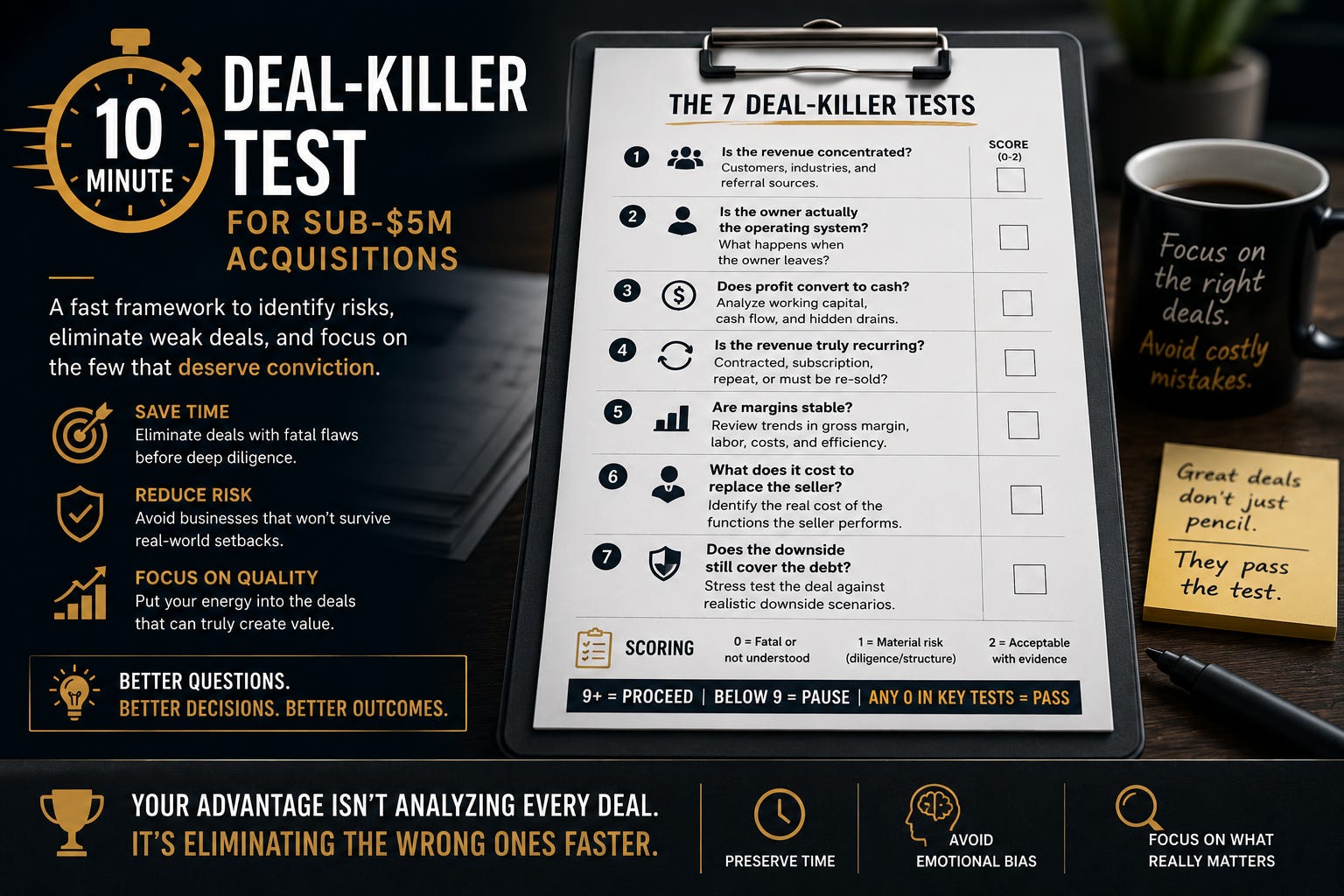
The 7 Critical Questions to Ask Yourself
Test 1: Is the revenue concentrated?
Do not stop at the largest customer’s percentage of revenue.
Ask:
What percentage of gross profit does that customer represent?
Is the relationship contractual, recurring, or based on the owner’s personal connection?
Does one industry account for most customers?
Does one referral source generate most new business?
A company can look diversified by customer count and still be concentrated by economics or lead source.
Test 2: Is the owner actually the operating system?
Look for signs that the seller personally controls:
Sales
Pricing
Hiring
Customer escalation
Vendor relationships
Technical knowledge
Quality control
Financial reporting
If the owner leaves and the company lose its judgment, relationships, and decision authority, you are not buying a management-run business.
You are buying a job plus a rebuilding project.
Test 3: Does profit convert to cash?
Advertised SDE and adjusted EBITDA are not the same as free cash flow.
Ask how much cash is absorbed by:
Accounts receivable
Inventory
Equipment replacement
Seasonal working capital
Customer deposits
Deferred maintenance
Debt service
A business can report strong earnings and still require the buyer to contribute cash repeatedly.
Working-capital analysis is not a closing detail. It is part of the purchase price and the survival plan.
Test 4: Is the revenue truly recurring?
Many sellers describe revenue as recurring because the same customers return.
That is not always recurring revenue.
Distinguish among:
Contracted recurring revenue
Subscription revenue
Repeat revenue
Project revenue from repeat customers
Revenue that must be resold every month
The more frequently revenue must be recreated, the greater the sales and execution risk.
Test 5: Are margins stable?
Five years of revenue growth can hide two years of margin compression.
Review:
Gross margin by year
Gross margin by customer or service line
Labor efficiency
Material costs
Discounting
Warranty or rework
Owner-performed labor
Revenue growth that produces less cash is not automatically a success story.
Test 6: What does it cost to replace the seller?
If the seller earns $250,000 but performs the work of a CEO, sales director, estimator, and operations manager, adding back the entire compensation can materially overstate buyer cash flow.
Estimate the market cost of the functions that must continue.
Then determine whether you will perform those functions yourself or hire them.
Your labor is not free merely because you own the company.
Test 7: Does the downside still cover the debt?
A base-case model should not be the only model.
Run at least one immediate downside case:
Revenue declines 10%
Gross margin falls three points
Largest customer leaves
Collections slow by fifteen days
Seller transition ends early
Then calculate what remains after:
Buyer salary
Operating expenses
Capital expenditures
Working capital
Debt service
Required reserves
If a modest setback creates a cash deficit, the deal is priced and structured for perfection.
A simple scoring method
Score each test:
0: Fatal or not understood
1: Material risk requiring diligence or structure
2: Acceptable with evidence
A deal scoring below 9 out of 14 should not receive full underwriting until the major issues are resolved.
A deal with a zero in customer concentration, owner dependency, cash conversion, or downside debt coverage may deserve an immediate pass.
The score is not a valuation model. It is an attention-allocation system.
The real value of a fast “no”
A fast rejection does three things:
1. Preserves time for stronger opportunities.
2. Reduces the chance that sunk costs create emotional commitment.
3. Forces the buyer to define risk standards before negotiating price.
The best acquisition entrepreneurs are the people who know which risks can be diligence, which can be structured, and which should simply be avoided.
Contact Information
Who am I?
I have been in Information Technology for over 25 years at various roles from Systems Engineering to Director lever positions. I have also been in real estate since 2019 focusing on fix and flips and in 2023 we shifted our focus to commercial real estate investing. I have acquired 246 units and continue to pursue real estate investments. I also have a Technology Firm helping companies incorporate technology, build systems integrations, and solve complex business problems with technology solutions. An example of this was our Multifamily Deal Evaluator application that was built with an operator, syndicator, and investor perspective so that anyone can learn to underwrite, analyze, and evaluate deals. If you are interested in the tool, you can check it out at KeptDo MFA PRO. If you like to learn more about what we do with technology, please visit our site Del Val Investment Group.
Outside of my family, my dog, and my Miami Hurricanes my passion is business, technology, and real estate. We are always looking to purchase businesses that have a unique niche and serve our vision of solving real world business problems with technology and we are always looking for real estate opportunities we can operate or invest in as joint partners that we can bring to our investors.
If you would like to reach out or learn more about my background, feel free to connect with me on the following platforms.

Manny Del Val | CEO and Founder Del Val Investment Group