


Dear Friends,
A lender can approve your acquisition and still leave you holding a business that cannot support your salary, its debt, its working-capital needs, and the first unexpected problem after closing.
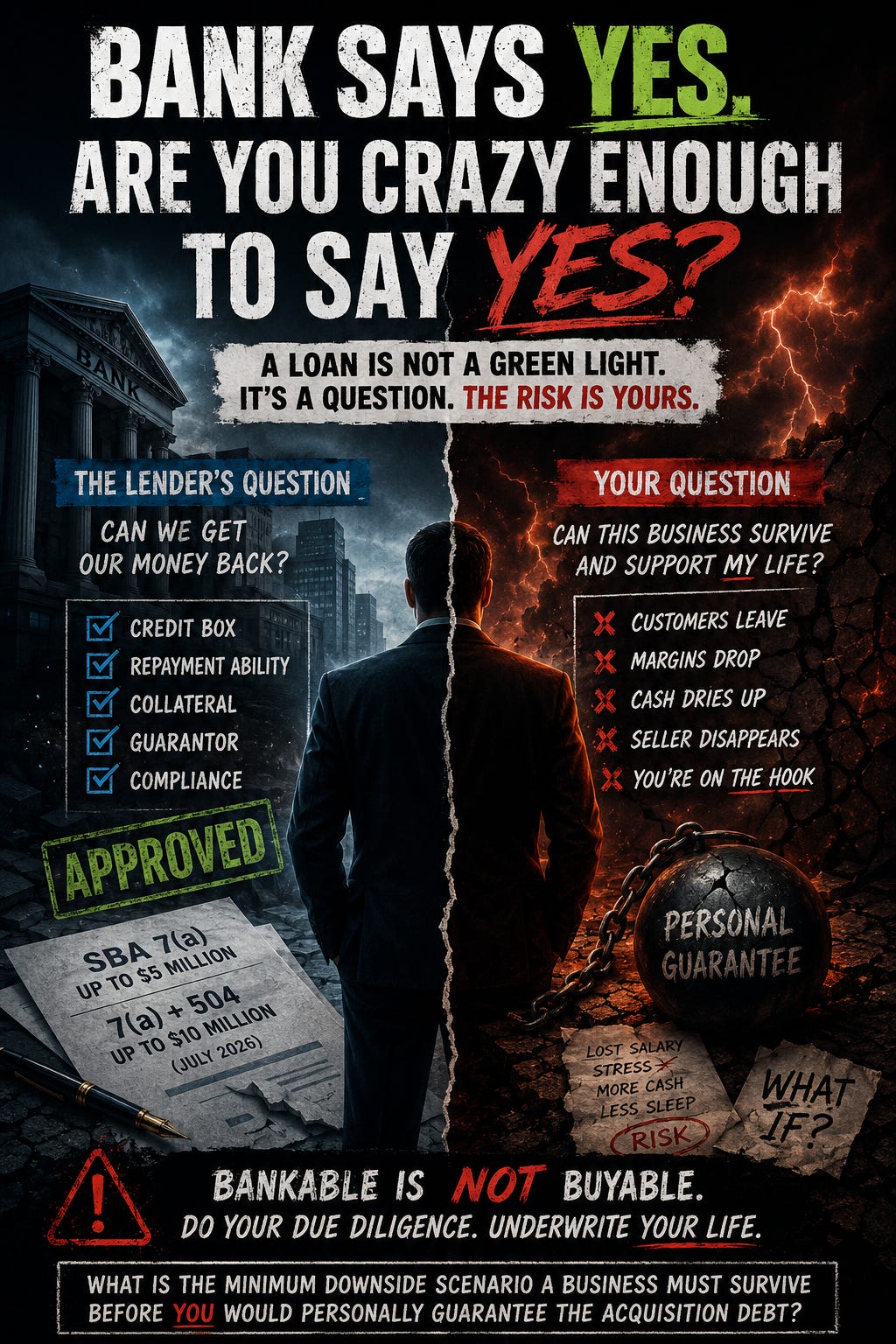
That is not a contradiction. It is a reminder that the lender and the buyer are answering two different questions.
The lender is asking: Does this transaction fit the credit box, and is there a reasonable path to repayment?
The buyer must ask: Is this a durable, transferable business that can pay me appropriately, survive a realistic downside case, and justify the personal and financial risk I am taking.
Those are not the same test.
The SBA 7(a) program remains one of the most powerful financing tools available to acquisition entrepreneurs. A standard 7(a) loan can be as large as $5 million. In July 2026, the SBA also announced that eligible borrowers may combine 7(a) and 504 financing for up to $10 million in cumulative SBA-backed financing. That increases access to capital. It does not reduce the need for disciplined buyer underwriting. [1][2]
A deal can be financeable and still be a bad acquisition.
Who Am I & Why Listen to Me?
So, who am I and why should you listen to me. I am Manny Del Val, been working in IT for over 25 years. I work for an IVY League Medical College as a Senior Manager, I also have my own technology consulting business, and I am a real estate investor with 246 doors, but most importantly I am a real person who has built business, been laid off, been successful, and worked hard for everything I got. I am passionate about a lot of things but outside of my family, my dog, and my Miami Hurricanes there is nothing I am more passionate about than business, technology, and commercial multifamily real estate. These news articles are away from me to connect and hopefully provide value, prevent you from making a mistake, educate you on something and inspire you to go out there and take control.
The bank is not your investment committee
A lender evaluates historical financial performance, repayment capacity, borrower qualifications, collateral where applicable, the transaction structure, and compliance with lending requirements. A good lender will challenge assumptions and may identify major weaknesses.
But the lender is not responsible for deciding whether the business fits your life, your capabilities, your risk tolerance, or your long-term strategy.
The lender does not have to operate the company after the seller leaves.
The lender does not have to explain to your spouse why the business needs another $150,000 of working capital.
The lender does not have to replace the salesperson who owned the customer relationships, rebuild a broken estimating process, or discover that the seller was working seventy hours a week to produce the advertised cash flow.
You do.
That is why financing approval should be treated as one diligence result, not as the final investment decision.
Where do you Start?
Start with cash flow you can actually keep. Many small-business opportunities are presented using Seller’s Discretionary Earnings, or SDE. SDE can be useful, especially for owner-operated companies, but it is not automatically the amount available to the buyer.
A buyer should rebuild the cash-flow waterfall from the ground up:
Begin with reported operating profit.
Validate every proposed add-back.
Remove truly nonrecurring expenses only when evidence supports the adjustment.
Subtract a market-rate salary for the work that must be performed after closing.
Subtract recurring capital expenditures.
Account for working-capital investment.
Subtract annual debt service.
Maintain a realistic operating reserve.
Then determine what remains for owner distributions and reinvestment.
This is where an apparently attractive business often changes shape.
For Example: Consider a company marketed at $600,000 of SDE.
The broker package includes $100,000 of add-backs. During diligence, you determine that only $55,000 is defensible. The seller handles sales, pricing, and customer escalations, so you budget $130,000 for a commercial manager or executive-level operator. The company has historically underinvested in equipment, requiring $45,000 of annual maintenance capital. Debt service is $250,000. You also need at least $75,000 of annual cash retention until liquidity is stabilized.
The calculation becomes:
Advertised SDE: $600,000
Unsupported add-backs removed: ($45,000)
Replacement management: ($130,000)
Maintenance capital expenditures: ($45,000)
Debt service: ($250,000)
Required cash retention: ($75,000)
Remaining pre-tax cash flow: $55,000
The bank may still see a financeable transaction because its underwriting definitions, adjustments, guarantor strength, or collateral position support the loan.
You should see a business with almost no room for error.
Stress the business, not only the loan
A common acquisition model asks whether the historical earnings cover scheduled debt service. A buyer-grade model asks what happens when the historical performance does not repeat perfectly.
At minimum, test four downside events.
1. The largest customer leaves
Customer concentration is not merely a percentage on a spreadsheet. It is a cash-flow event.
If the largest customer represents 18% of revenue but 28% of gross profit, the effect is more severe than the revenue percentage suggests. Ask whether the corresponding labor and overhead can be removed quickly or whether most costs remain.
2. Gross margin falls
A two- or three-point reduction in gross margin can erase a significant portion of debt-service cushion in a labor-intensive or materials-heavy business.
Model wage increases, supplier repricing, discounting, and warranty work. Do not assume that all revenue dollars have equal economic value.
3. Collections slow
A profitable business can become a liquidity problem when customers pay in sixty days and vendors or employees must be paid in fifteen.
Working-capital analysis is a core part of financial diligence because the normal level delivered at closing can materially affect the economics for both buyer and seller.
4. The seller becomes unavailable
Transition agreements are important, but buyers should not build a survival plan around a seller’s continued enthusiasm.
Model the company as though the seller becomes less available than expected. Which relationships, approvals, passwords, pricing decisions, vendor terms, and undocumented processes immediately become vulnerable?
The personal guarantee changes the risk calculation
Acquisition entrepreneurs are often drawn to SBA financing because it can reduce the equity check required at closing. That capital efficiency is real.
But a low buyer injection does not mean the buyer’s downside is limited to the amount invested.
The risk can include:
The personal guarantee
Lost salary during a turnaround
Additional working-capital contributions
Legal and professional costs
Opportunity cost
Personal reputation
Stress on family and health
A deal requiring $150,000 at closing may create exposure far beyond $150,000.
That does not make SBA financing inappropriate. It means the buyer should demand enough return, liquidity, and downside protection to justify the broader risk.
Build a buyer approval test
Before submitting a final offer, define the conditions under which you approve the acquisition.
A disciplined buyer approval test may include:
Minimum debt-service coverage in the base case
Minimum debt-service coverage after a defined revenue or margin decline
Maximum customer and vendor concentration
Minimum post-close liquidity
Maximum dependence on the seller
Required management depth
Required recurring or repeat revenue
Maximum maintenance capital expenditure
Minimum cash compensation for the buyer
Specific walk-away conditions
The numbers should reflect the business and your circumstances. There is no universal threshold that makes every deal safe.
The point is to set the rules before deal momentum, sunk costs, and emotional attachment make discipline harder.
Bankable is not the same as buyable
The most dangerous sentence in acquisition underwriting may be: “The lender is comfortable with it.”
The lender’s comfort matters. It is not a substitute for yours.
The lender is underwriting repayment.
You are underwriting repayment, operations, leadership, personal risk, family impact, future growth, and the possibility that the business you buy is materially different from the business the seller operated.
Use the bank’s approval as a valuable data point.
Then conduct the harder analysis yourself.
Because the lender can approve the loan.
Only you can approve the life that comes with it.
Practical Buyer Checklist: Bankable vs. Buyable
Before moving forward, answer these questions in writing:
What is sustainable cash flow after replacing the seller’s labor?
Which add-backs have documentary support?
How much working capital is required during a normal month and a bad month?
What happens to cash flow if revenue falls 10%?
What happens if gross margin falls three points?
Which customer, employee, or supplier loss creates an immediate crisis?
How much personal liquidity remains after closing?
Can the business support debt service, a proper salary, reserves, and reinvestment?
What specific fact would cause me to walk away?
Engagement Call to Action: What is the minimum downside scenario a business must survive before you would personally guarantee the acquisition debt?
Educational disclaimer: This article is for educational purposes only and is not legal, tax, accounting, lending, or investment advice. Buyers should consult qualified professional advisers and their lender regarding the facts of a specific transaction.
Contact Information
If you would like to connect with me or learn more about how Del Val Investment Group helps solve real business problems using technology, please reach out on the platforms below.

Manny Del Val | CEO and Founder Del Val Investment Group