


I had a signed LOI for a $1.5 million company. Months of work behind it. Then I spoke to by SBA broker and had to put my conditions in writing and the sellers decided they’d rather not sell at all.
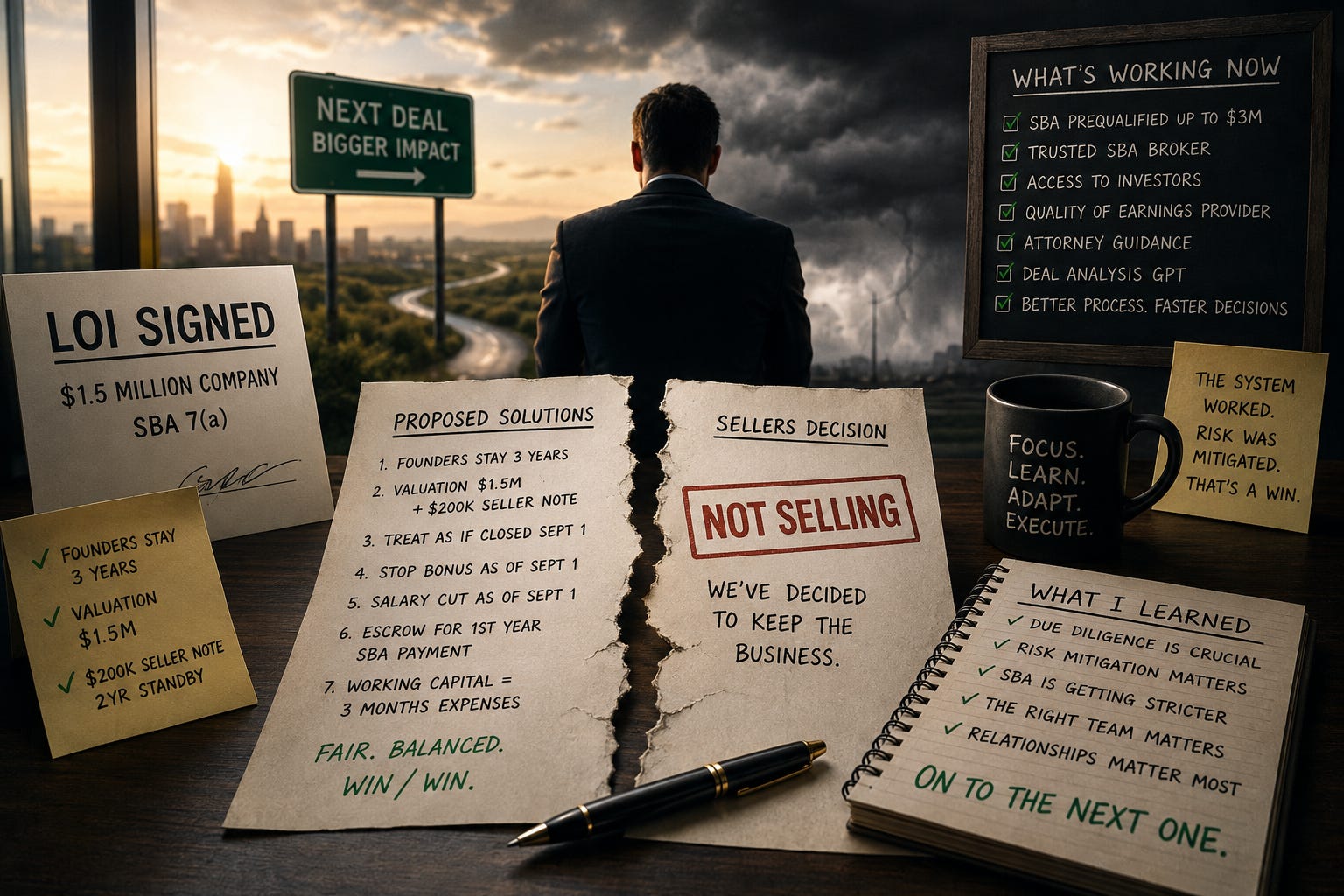
The Deal
The company was a technology related business, with my technology background and over 12 years in IT Manage Services and understanding recurring revenue model I felt I had a good grasp on how to move the business forward into a recurring revenue model from what they were doing today.
The deal structure was a 60% majority stock purchase at a $1.5M valuation, SBA 7(a). Then digging deeper into the deal and into diligence three things surfaced:
Key Man Risk
Client Concentration
Lumpy Revenue
Based on that and my conversation with my SBA Broker we had to find a way to mitigate risk and have the business be financeable via the SBA 7(a) program. Here were the parameters that had to be met.
You might ask what these risks are all about let me explain.
Key Man Risk - This company was run by 2 people there was no team. No sales team, no operations team. Just two guys to their credit executing on a very successful business with super high gross margins. What attracted me to it in the first place.
Client Concentration - This is when the source of revenue for a company comes from a specific client. In this case one client was 49% of the revenue.
Lumpy Revenue - This is when the monthly revenue is not consistent you can have a month where the company brings in 500K and 6 months of negative revenue. On a yearly P&L it looks great, but when you break it down monthly it’s a problem. You see a company is not run yearly there are monthly obligations that you need to account for and if the revenue is not there, that’s a problem.
The Proposed Resolution
Founders to stay post-acquisition for 3 years minimum: This was to mitigate the key man risk and the plan was for me to use my experience to help build an operations and sales team moving the founders into a CTO and CRO role respectively. I had estimated an 18-month trajectory to build those teams out. The founders agreed on this one from the beginning
Valuation was dropped to $1.5M and a 200K seller note was created with a 2yr standby: This was addressing the fact that the top 3 clients were 75% of the business and they only had 16% recurring revenues, so it addressed the client concentration risk.
Founders agreed to this as well
Treat the company as if it closed on Sept 1st
Bonus compensation for the founders must stop as of Sept 1st and be revaluated based on the agreed upon compensation plan.
Founders’ salary cut to the agreed compensation level starting Sept 1st.
Escrow account with a forgivable note equal to the 1st years SBA payment to ensure the SBA loan would be paid in the event revenues were not at the guaranteed level.
Working Capital equal to 3 months of expenses to be set aside at closing.
These last 4 where the areas of contention and were meant to address the lumpy revenue challenges.
Here is my thought process and what the SBA told me.
Because of the lumpiness of the revenue and the client concentration it was going to be hard to finance this business. They needed to ensure that there were enough reserves in place in the event of a catastrophic failure. That is why they asked for working capital reserve and to have the business treated as it closed on Sept 1st.
I was trying to put together something that was a win/win for all parties. I had to protect my interest but at the same time I wanted to ensure the founders were compensated for any deal they closed prior to closing and I made sure to put that in the compensation plan. I also created the plan in a way that if the target revenues were met, they would be making what they were making today from a salary perspective and if they pushed themselves to 50% growth, they would be highly rewarded. My plan put no cap on compensation, and I also had them sharing equity at their given equity percentages.
I though the comprise was fair, but I can understand the seller’s situation. They are asked to have their company fundamentally change without it closing. They would essentially give control of how the company’s revenue would be processed, when they can take their bonuses, and how much they are getting paid. It is a lot to ask but they would be getting a nice chunk of cash up front and have 40% of future earnings and equity in the company.
What I learned
Closing a deal is HARD. Even when you have good people on both sides who are legitimately trying to make the deal work. I have nothing but the best things to say about the sellers. They are hardworking, flexible, smart, and genuinely good human beings. Nothing but the best for them.
Things can look great on paper when you're looking at a business with 83% gross margins you get excited but dig deeper what does it look like on a monthly basis. Is there revenue coming all in one month or in a couple of months and is that month floating operations for the year.
The SBA is very strict and it’s getting stricter by the minute. It is going to get harder to make a deal work not easier. New provisioning supposedly is meant to protect first time buyers, but in my opinion, it’s making it harder for buyers and for Americans to have the American dream.
Due Diligence is crucial and having a good SBA broker that you can work with and run things with is a key member of your team. I talked to 2 brokers and a lender in this process. Originally, I liked the lender the best, but they went with a hard tactic of having me sign right as they gave me the term sheets without really understanding the structure of the deal. They also mentioned things that I later found out did not really work like that such as collateral on your home if its less than 25%. The policy they had was specific to their bank not the SBA.
The second broker is very good and super knowledgeable but also strict and you have to sign an exclusivity contract with turned me off from the start.
The third broker is my guy, he answered all my emails, explained everything to me, gave me ideas of how things might work, and explain the challenges that will come with the SBA and also with the deal and the risk that I was assuming and helped me find ways to mitigate it. I will be using this man on all my future deals.
What Is Working Now
I have a better understanding of the business buying process.
I have an SBA Broker on my team that I will be using.
I am SBA prequalified for up to $3 million acquisition.
I have access to investors as part of my business accelerator program.
I met a Quality of Earnings provider that I liked that could be a potential addition
My sister is my attorney, she gives me initial guidance, but when things get serious, I will bring an attorney who is an expert in these types of business transactions.
I have created a Deal Analysis GPT that will allow me to model deals and understand risks much better and much faster and give deals a score so not to pursue anything that doesn’t meet my threshold.
Having my SBA Broker in place and my Deal Evaluators will help me make quicker decisions and move faster.
Conclusion
The system worked as it should. Risk was mitigated and in the end the risk was too much to assume for me and the sellers decided it was better for them to keep their business.
This in my book is a win, I learned so much through this process that I can take with me on to the next deal evaluation. The education you learn is something no one can take away from you. The sellers are amazing people with a solid business that I hope nothing for the best for them. If I can ever help them in any way I would love to.
I am the type of person that values relationships, good human beings doing good things, hard honest work, giving back, and doing the right things. I build an entire 25-year career on one simple principle “Do What You Say You Are Going To Do”. Lately I have found that this concept has become more and more difficult for people to follow. In the end business is about people, processes, and product.
Call To Action
Comment or message me:
With the deal you are looking at right now what’s making you hesitate. I read every comment.
This is me Taking IT Apart If you found value please subscribe and share below:
Contact Information
Who am I?
I have been in Information Technology for over 25 years at various roles from Systems Engineering to Director lever positions. I have also been in real estate since 2019 focusing on fix and flips and in 2023 we shifted our focus to commercial real estate investing. I have acquired 246 units and continue to pursue real estate investments. I also have a Technology Firm helping companies incorporate technology, build systems integrations, and solve complex business problems with technology solutions. An example of this was our Multifamily Deal Evaluator application that was built with an operator, syndicator, and investor perspective so that anyone can learn to underwrite, analyze, and evaluate deals. If you are interested in the tool, you can check it out at
If you like to learn more about what we do to help small and mid-size businesses with their processes and technology, please visit our site
Outside of my family, my dog, and my Miami Hurricanes my passion is business, technology, and real estate. We are always looking to purchase businesses that have a unique niche and serve our vision of solving real world business problems with technology and we are always looking for JV real estate opportunities we can operate or invest in as joint partners.
If you would like to reach out or learn more about my background, feel free to connect with me on the following platforms.

Manny Del Val | CEO and Founder Del Val Investment Group