


Dear Friends,
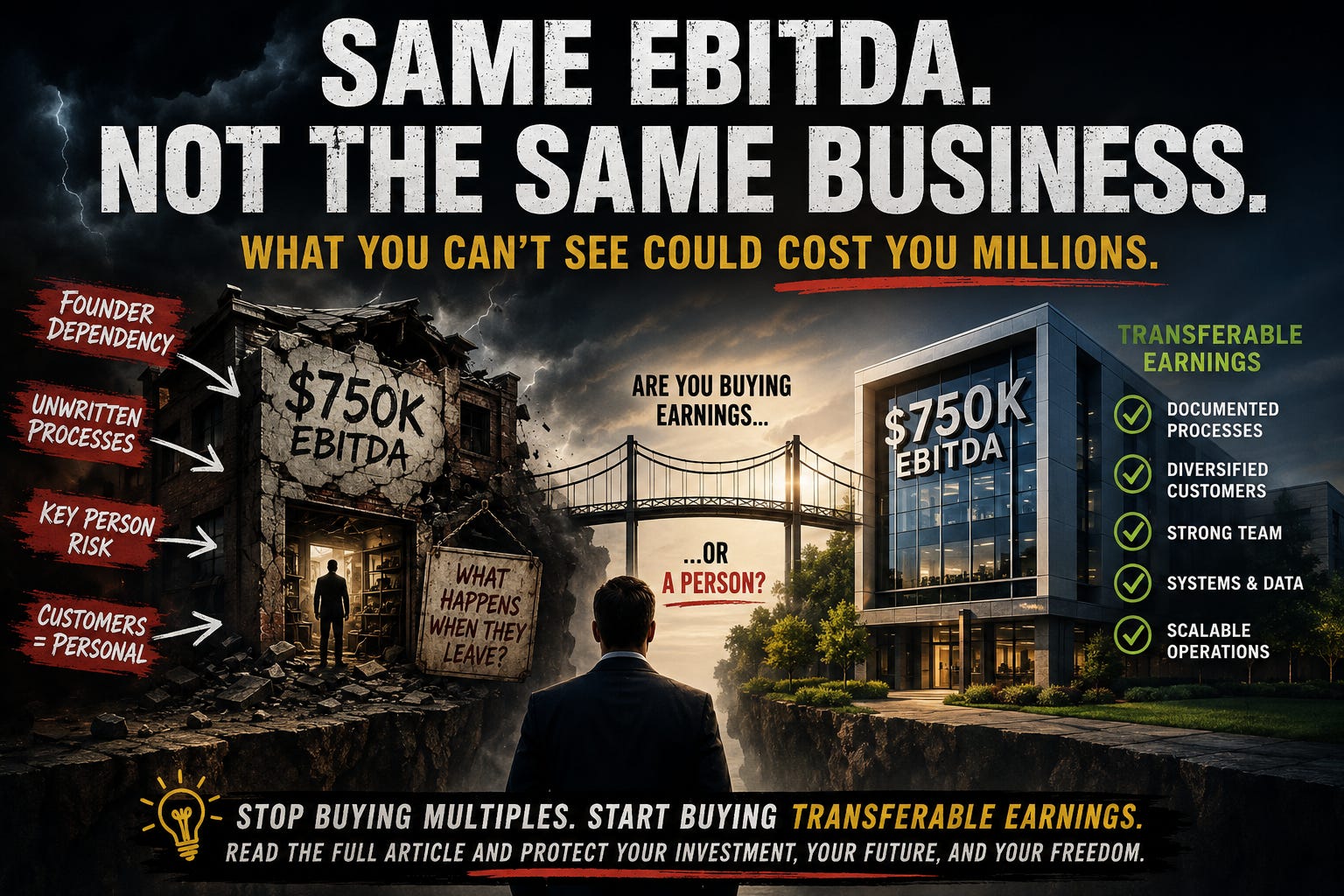
Two companies can report the same revenue, the same adjusted EBITDA, and the same growth rate—and still deserve completely different valuations.
Company A has a management team, signed customer agreements, documented procedures, a functioning CRM, delegated pricing authority, and a repeatable sales process.
Company B has a talented founder whose phone contains the customer list, whose memory contains the operating system, and whose personal credibility closes every important sale.
On paper, both companies may produce $750,000 of adjusted EBITDA.
In reality, only one may be transferring $750,000 of earnings to the buyer.
The other may be transferring a collection of assets, employees, and customer relationships that must be reconstructed after the seller leaves.
This is why buyers should stop thinking only in terms of EBITDA multiples and start thinking in terms of transferable earnings.
The number is not the business
Financial diligence matters. A quality-of-earnings analysis can help determine whether reported earnings are recurring, correctly stated, and supported by the underlying accounting records. Working-capital and debt-like-item analyses can also materially change the final purchase economics.
But even a technically sound quality-of-earnings report does not answer every operating question.
It may validate that the company historically earned $750,000.
It cannot, by itself, prove that the company will continue earning $750,000 after the person who created the customer relationships, solved the unusual problems, approved every price exception, and calmed every important employee is gone.
That requires operational diligence.
Transferability is the bridge between historical earnings and buyer-owned earnings.
The five forms of seller dependency
Most buyers recognize obvious owner dependence. The seller works seventy hours a week, personally handles sales, or signs every check. The more dangerous dependencies are often less visible.
1. Revenue dependency
The seller may not be listed as the salesperson, but customers may still view the relationship as personal.
Ask:
Which customers call the owner directly?
Who negotiates renewals?
Who resolves pricing disputes?
Which accounts have never interacted meaningfully with another leader?
Are contracts assignable, and do customers have change-of-control rights?
A customer relationship is not transferable merely because the customer has paid the company for years.
2. Knowledge dependency
Many owner-operated businesses function through unwritten judgment.
The owner knows which jobs to avoid, which vendor can solve an emergency, which employee can handle a difficult customer, and when an estimate contains hidden risk.
This knowledge may never appear in a procedure manual because the owner does not experience it as a process. It feels like common sense developed over twenty years.
To the buyer, it is undocumented intellectual property.
3. Decision dependency
A company may have managers, but they may lack actual authority.
If every discount, hire, purchase, customer exception, and vendor decision requires owner approval, management exists in title more than in function.
The buyer is not acquiring a self-running management system. The buyer is acquiring a queue of decisions waiting for a replacement owner.
4. Employee dependency
Key employees may be loyal to the seller rather than committed to the institution.
Compensation arrangements may be informal. Career paths may not exist. Important people may stay only because the seller has repeatedly promised something that was never documented.
The acquisition can trigger uncertainty even when the buyer intends to preserve the team.
5. Vendor and credential dependency
Licenses, certifications, bonding capacity, supplier terms, referral relationships, and purchasing discounts may depend on the seller personally.
A company can lose margin or even its ability to operate when those items do not transfer cleanly
Customer concentration is only one type of concentration
Buyers correctly focus on customer concentration, but concentration can appear anywhere the company has a single point of failure.
Examples include:
One estimator produces nearly every profitable quote.
One office manager understands billing and collections.
One technician holds a required license.
One supplier provides a specialized material.
One lead source generates most new customers.
One founder maintains all system passwords.
One spreadsheet contains the real operating data.
A company can have a diversified customer base and still have extreme operating concentration.
The practical question is not merely, “What percentage does the largest customer represent?”
It is: What single loss would most quickly reduce cash flow, and how difficult would it be to replace?
Build a transferability score
A transferability score should evaluate the systems that allow performance to continue without the seller.
Score each category from one to five.
Revenue
Is revenue recurring, contracted, repeat, or constantly resold?
Are customer relationships institutional or personal?
Is pipeline data visible?
Can sales performance be reproduced by someone other than the owner?
Operations
Are core procedures documented?
Are quality standards measurable?
Are exceptions tracked?
Can work continue when one key person is absent?
People
Is there management depth?
Are compensation and responsibilities documented?
Are retention risks understood?
Can managers make decisions without the owner?
Technology and data
Does the company use systems of record?
Are customer’s, financials, and operating data complete and accessible?
Are passwords, licenses, and integrations controlled by the company?
Can the buyer see performance without manually reconstructing it?
Vendors and compliance
Are key relationships documented?
Do required licenses transfer or remain valid?
Are supplier terms market-based?
Are there alternative sources for critical inputs?
Adjust earnings before debating the multiple
Buyers often negotiate whether a business deserves a four-times or five-times multiple.
That debate can be premature.
First determine the earnings base to which the multiple should apply.
Assume a company reports $800,000 of adjusted EBITDA. During operational diligence, you identify the following:
Replacement sales leadership: $140,000
Additional operations manager: $110,000
Lost gross profit from likely customer attrition: $90,000
Required technology and process investment: $60,000 annually for the first two years
The buyer is not acquiring $800,000 of immediately transferable EBITDA.
The buyer may be acquiring approximately $400,000 to $500,000 of post-transition earnings, plus an opportunity to rebuild toward the historical number.
That difference should affect:
Purchase price
Seller financing
Transition length
Working-capital reserve
Employment agreements
Retention incentives
Representations and indemnification
The buyer’s willingness to proceed
Ask questions the CIM cannot answer
A confidential information memorandum usually describes the company at its best.
Operational diligence should search for what stops, slows, or becomes uncertain when the owner is absent.
Ask:
What did not get done during the owner’s last vacation?
Which customers insist on speaking with the owner?
Who can quote a large job without approval?
Who can hire or terminate an employee?
Which process exists only in someone’s head?
Which system would fail if one employee left tomorrow?
What information does the owner review every morning?
Which decisions are delayed when the owner is unavailable?
What has the seller attempted to delegate unsuccessfully?
The quality of the answers matters. So does the speed with which the company can produce evidence.
A business that claims to be systematized but cannot show reports, procedures, authority matrices, contracts, or performance dashboards is not yet systematized.
Price the company you will own
The seller is entitled to describe what was built. The buyer must price what will transfer.
That does not mean punishing founders for being important. Many excellent small businesses were built through extraordinary founder effort.
It means recognizing that a buyer cannot pay a premium for an operating capability that disappears at closing.
The cleanest acquisitions convert personal goodwill into institutional capability before the transaction:
Customer relationships are shared.
Leadership authority is real.
Processes are documented.
Data is visible.
Key employees are retained.
Vendor and license dependencies are addressed.
The seller’s knowledge is transferred through a structured plan.
When those conditions exist, the buyer is not simply purchasing a history of earnings.
The buyer is purchasing a business that can continue producing them.
That is what deserves the multiple.
Call To Action:
What is the most dangerous form of owner dependency you have encountered in a small business?
Educational disclaimer: This article is for educational purposes only and is not legal, tax, accounting, or investment advice.
If you found this article valuable or educational consider subscribing the newsletter and sharing it with friends.
Contact Information
Who am I?
I have been in Information Technology for over 25 years at various roles from Systems Engineering to Director lever positions. I have also been in real estate since 2019 focusing on fix and flips and in 2023 we shifted our focus to commercial real estate investing. I have acquired 246 units and continue to pursue real estate investments. I also have a Technology Firm helping companies incorporate technology, build systems integrations, and solve complex business problems with technology solutions. An example of this was our Multifamily Deal Evaluator application that was built with an operator, syndicator, and investor perspective so that anyone can learn to underwrite, analyze, and evaluate deals. If you are interested in the tool, you can check it out at KeptDo MFA PRO. If you like to learn more about what we do with technology, please visit our site Del Val Investment Group.
Outside of my family, my dog, and my Miami Hurricanes my passion is business, technology, and real estate. We are always looking to purchase businesses that have a unique niche and serve our vision of solving real world business problems with technology and we are always looking for real estate opportunities we can operate or invest in as joint partners that we can bring to our investors.
If you would like to reach out or learn more about my background, feel free to connect with me on the following platforms.

Manny Del Val | CEO and Founder Del Val Investment Group