


Dear Friends,
The SBA changed its acquisition rules on October 1.
I have seen plenty of summaries of SOP 50 10 8.1 since then. Most explain what changed in the document.
That is useful, but it is not the question I care about as a buyer.
The question I care about is:
What do I need to know about the rules that changes the way I need to evaluate, structure, and look at acquisitions because of the new rules?
That is where this gets interesting.
SBA SOP 50 10 8.1 became effective October 1, 2026. Change-of-ownership transactions are now governed through Appendix 15, and the SBA has organized them into four categories:
Initial Acquisition
Business Expansion
Owner Buyout
ESOP/Cooperative.
For most buyers acquiring control of a company they did not previously own or work for, the transaction will generally fall into the Initial Acquisition category.
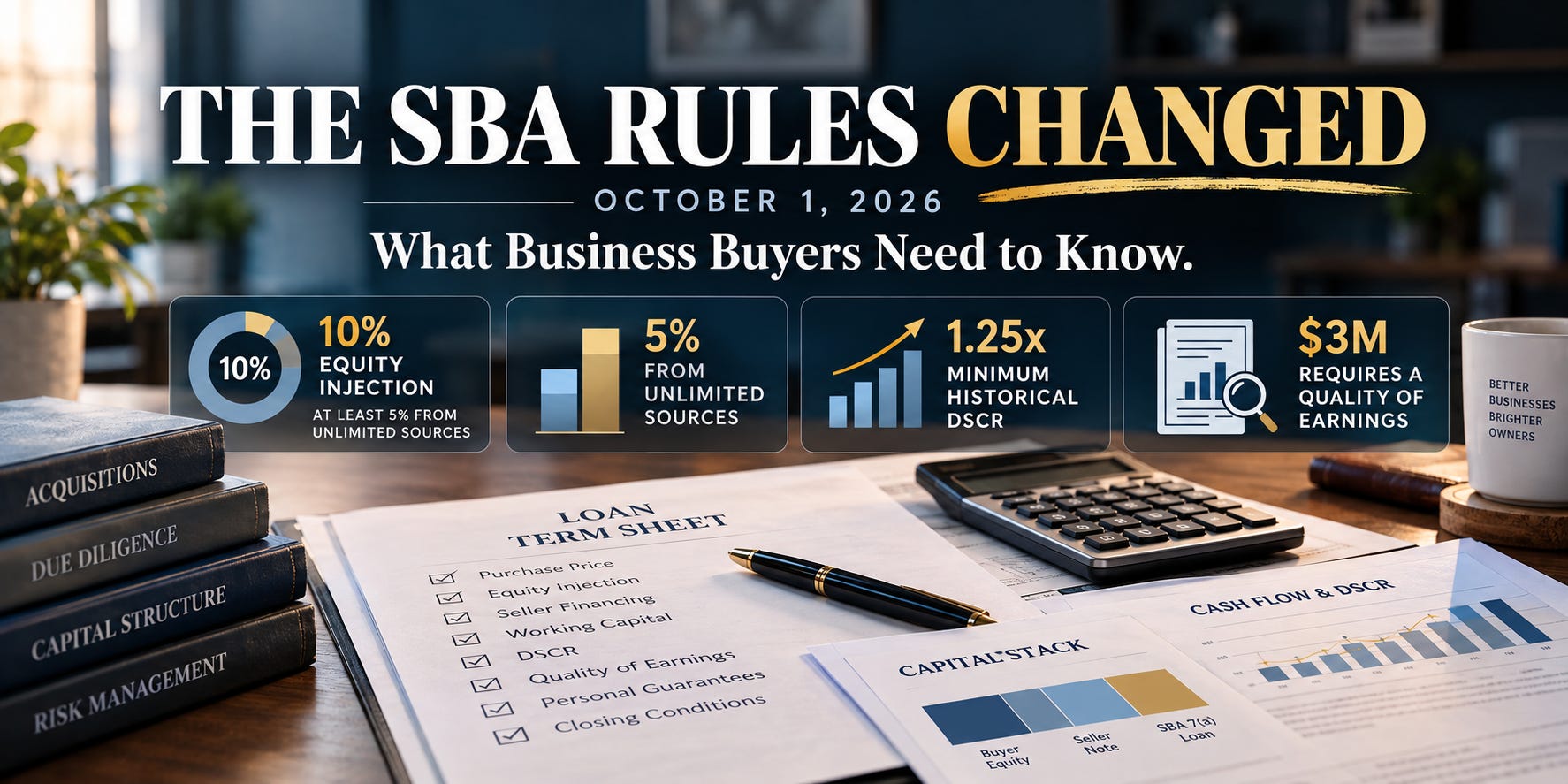
For an Initial Acquisition, four numbers immediately matter to me:
10% required equity injection.
At least half of that required injection must come from Unlimited sources. That means you need to come up with at least 5% from your own sources.
1.25x minimum historical or adjusted historical debt-service coverage.
A Quality of Earnings report once Business Purchase Price reaches $3 million for the applicable acquisition categories.
The 10% requirement did not change as much as originally thought but the structure underneath it did and that may have a bigger impact on searchers.
The change I would pay the most attention to: the new “5% rule”
The required injection for an Initial Acquisition is still 10% of total project cost and cannot be reduced or eliminated.
What changed is where that money can come from.
SOP 8.1 divides injection sources into two buckets.
Unlimited sources
These can fund up to 100% of the required injection.
They include:
Unborrowed cash
Qualifying personal borrowing where repayment can be demonstrated from a source outside the acquired business
Qualifying grants without repayment or claw back provisions.
The SOP also recognizes certain prepaid transaction expenses.
Limited sources
These include:
standby debt
seller debt on full standby
qualifying non-controlling minority equity investments.
Those sources, combined, may provide no more than half of the required equity injection.
That is why the lenders I am speaking with have started calling this the 5% rule.
If an Initial Acquisition requires a 10% injection, at least half of that 10% effectively has to come from an Unlimited source.
For a self-funded buyer, that matters.
A common acquisition structure has been for the buyer to put in a relatively small amount personally and raise the rest of the required equity from passive investors.
Raising equity from passive investors can become much harder under the new rule.
A $2 million example
Assume I am buying a business for:
$2,000,000
For simplicity, assume there is no real estate.
Required 10% injection: $200,000
Potential SBA financing: $1,800,000
Now assume I planned this structure:
My Cash: $50,000
Passive minority investor: $150,000
SBA 7(a): $1,800,000
Total: $2,000,000
Under the new rules, the problem is not whether I raised $200,000.
I did. The problem is where the $200,000 came from.
If the $150,000 investor contribution is a qualifying non-controlling minority investment used toward the required injection, it falls into the Limited bucket.
The maximum Limited-source contribution toward a $200,000 required injection is:
$200,000 × 50% = $100,000
That means at least: $100,000 has to come from Unlimited sources.
My proposed $50,000 buyer cash plus $150,000 passive-investor structure therefore does not satisfy that composition test.
What A basic compliant injection could look like
Unlimited source: $100,000
Limited source: $100,000
Required injection: $200,000
And the Limited bucket is shared.
I cannot use $100,000 of passive investor equity plus another $100,000 seller standby note and claim both toward the same $200,000 required injection. Together, the Limited sources are still capped at $100,000.
For buyers raising capital from passive investors, this is not a small technical change.
It changes capital-stack design.
The DSCR Problem
The equity rule gets attention because it affects the cash buyers have to bring.
The change to debt-service coverage may have a bigger impact on valuation.
Under the previous SOP, the minimum was generally 1.15x and projections could play a role in demonstrating coverage. Under SOP 8.1, an Initial Acquisition requires 1.25x DSCR, measured using historical or adjusted historical performance.
Post-closing projections still have to be evaluated, but they cannot be used to cure a transaction that fails the required historical coverage test.
Go back to the same $2 million acquisition.
Assume the following:
SBA debt: $1,800,000
Interest rate: 9%
Amortization: 10 years
Adjusted historical EBITDA: $320,000
The monthly payment on $1.8 million at 9% over 10 years is approximately: $22,801.64
Annual debt service: $273,619.67
DSCR:
$320,000 ÷ $273,619.67 = 1.17x
Under a 1.15x threshold, the transaction could potentially have cleared the minimum, subject to the rest of underwriting. At 1.25x, it does not.
Same company.
Same price.
Same cash flow.
Different result.
To support 1.25x coverage on $320,000 of qualifying EBITDA:
$320,000 ÷ 1.25 = $256,000
The business can support approximately $256,000 of annual acquisition debt service.
At 9% over 10 years, that supports roughly: $1.684 million of amortizing debt instead of $1.8 million.
That leaves roughly a $116,000 financing gap which has to be solved.
The seller can reduce the price.
The buyer can put in more equity.
Seller financing can absorb part of the gap.
Or the parties can combine all three.
That is why I think these rules are going to affect valuation negotiations, not just loan underwriting.
Seller notes just became more important
Seller financing was already useful in acquisition deals. I think it becomes more strategically important now.
A seller note placed on full standby does not create current principal or interest payments during the standby period, so it can help reduce the amount of amortizing acquisition debt. That can improve current DSCR.
But the buyer needs to understand two separate issues.
If the seller note is being used as part of the required equity injection, it is a Limited source and shares the 50% cap with other Limited sources.
Seller financing above that injection amount may still be useful to bridge valuation or financing gaps, but the lender has to approve the structure, subordination and repayment terms.
I would therefore stop locking myself into detailed seller-note repayment terms before the SBA lender has reviewed the transaction.
Six months ago, an LOI might have said:
$200,000 seller note, 6% interest, five-year amortization, payments beginning in Year 2.
Today I would leave more room:
Seller financing, including amount, standby requirements, subordination, interest and repayment terms, will be subject to mutually acceptable terms and SBA/senior-lender requirements.
The seller note can be a negotiating tool.
I would not turn it into a financing problem by defining it too early.
Required Quality of Earnings Report at $3 million
Another number buyers need to know is: $3 million.
For Initial Acquisitions and Business Expansions with Business Purchase Price of $3 million or more, a Quality of Earnings report is required. The Business Purchase Price calculation excludes owner-occupied commercial real estate for this test.
This is not just another diligence report that gets thrown into the closing binder.
The lenders I am talking with are treating the QoE as lender-level diligence.
SBA’s September 25 technical update also clarified that a QoE already prepared for the applicant may be used if supported by a reliance letter or a secondary review by another firm, while the report may not be prepared by or for the seller.
From a buyer’s perspective, the practical issue is simple.
If the QoE does not support the earnings being used to justify the purchase price and debt structure, the financing can change.
Which means the capital stack can change.
Which means my cash requirement can change.
Which means the LOI needs to anticipate it.
Do not confuse the down payment with your real cash requirement
This is another place where buyers can get themselves in trouble.
A $2 million acquisition with a $200,000 injection does not necessarily mean I need $200,000.
I also have to think about:
Diligence and transaction expenses;
Working Capital;
Closing Adjustments;
Lender-required post-close liquidity;
Reserves for things that do not go according to plan.
SBA 7(a) proceeds can be used for permanent working capital as well as the acquisition itself.
Suppose that $2 million company needs another: $200,000 of operating working capital If that working capital is included as an eligible use in the SBA project, total project cost becomes: $2,200,000
Required 10% injection: $220,000
Potential SBA financing: $1,980,000
I increased the minimum injection by $20,000, but I potentially avoided closing the business and immediately needing to find another $200,000 to fund payroll, receivables and vendors.
Whether a particular transaction can support that additional debt is another question.
It still has to satisfy DSCR, valuation, loan limits and lender underwriting.
But this is the way I think buyers should analyze the deal.
Not: How much is my down payment?
Instead: What is the total amount of capital and liquidity required to buy this business and operate it safely after closing?
Those are very different questions.
Personal guarantees still matter
SBA financing sometimes gets discussed as though the government guaranty somehow reduces the buyer’s personal exposure.
That is not what the guaranty does. The SBA guaranty protects the lender.
Under SOP 50 10 8.1, an individual owning 20% or more directly or indirectly generally must provide an unlimited full guaranty. If no owner holds 20% or more, at least one owner still has to provide a full unconditional guaranty. SBA or the delegated lender can also require additional guaranties for credit or operational reasons.
A non-owner spouse does not automatically become a full guarantor simply because the borrower is married, but the spouse may have to execute appropriate collateral documents when jointly held property is pledged.
Collateral is a separate issue.
Where there is a collateral shortfall, the current acquisition rules can require the lender to take available equity in personal real estate of covered borrowers, 20%+ owners and guarantors, subject to the SOP’s limitations and exceptions.
That changes how I think about risk.
I am not simply putting $200,000 into a $2 million business.
I may also be exposing:
My personal guaranty
Personal real estate
Additional Liquidity,
Years of future cash flow.
That does not mean SBA financing is bad. It means I need to price the risk correctly.
My LOI would look different today
The biggest change I would make is simple:
I would stop writing an LOI as though 90% SBA financing is guaranteed.
Instead of:
The purchase will be funded with 90% SBA financing and 10% buyer equity.
I would write something closer to:
The transaction is anticipated to be financed through an SBA 7(a) loan for up to approximately 90% of eligible project costs, together with Buyer equity and, if applicable, Seller financing, subject to lender underwriting, SBA eligibility, required debt-service coverage, satisfactory business valuation and final approval.
I would also broaden the financing contingency. The deal should be conditioned on satisfactory:
SBA eligibility
Lender Underwriting
Historical or Adjusted Historical Cash Flow;
Required DSCR;
Business Valuation;
QoE where applicable;
Equity Injection;
Collateral and Guaranty Requirements.
I would explicitly connect the purchase price to the earnings that justified it. Something like:
Purchase Price is based upon the financial information provided to Buyer and Seller’s represented adjusted earnings. Final Purchase Price and transaction structure remain subject to Buyer’s verification of historical financial performance and the earnings recognized by Buyer’s SBA lender for underwriting purposes.
That is not a license to retrade a seller. It is a recognition that I should not be locked into a valuation built on $600,000 of represented SDE if the lender later determines only $500,000 is supportable.
I would also address working capital much earlier.
Instead of simply saying: $2 million, cash-free/debt-free
I would want the economics to read more like:
$2 million, cash-free/debt-free, subject to a normalized working-capital target and sufficient lender-approved operating liquidity at closing.
And on deals at or above the $3 million QoE threshold, I would explicitly require seller cooperation with the financial diligence and access to the bank statements, general ledger, tax returns, customer-level revenue and supporting records needed to complete it.
What I would do moving for
If I were actively searching today, I would take five actions.
1. Re-underwrite every active deal
The SBA floor for an Initial Acquisition is 1.25x.
I would calculate DSCR using historical or adjusted historical earnings.
Not what I think I can do after closing.
Not the seller’s five-year forecast.
Not the synergies I believe I can create.
This would not become my investment standard.
For my own acquisitions, I want verified historical cash flow supporting closer to 1.35x–1.50x DSCR, after a market-rate owner salary, recurring capex and acquisition debt.
Then I want to stress the business.
What happens if earnings fall 10%?
If a deal barely survives at 1.25x, I either lower the price, reduce the debt, restructure it or walk away.
2. Have the lender classify the equity before I negotiate around it
I would send the lender my sources and uses and ask:
“Please classify every source of my required injection as Unlimited or Limited under SOP 50 10 8.1.”
I want that answer before the LOI. Not four weeks into underwriting.
3. Calculate the real capital requirement
I would stop treating the required injection as the total cash needed.
My calculation is:
Required injection
+ transaction and diligence costs
+ working capital
+ closing adjustments
+ required post-closing liquidity
= real capital requirement
That is the number that matters.
4. Revisit the seller note and LOI
I want to know before submitting the offer whether seller financing is being used:
to satisfy part of the required injection, to improve DSCR, to bridge a valuation gap,
or simply to align the seller with the transition.
Those are different jobs. The note should be structured accordingly.
5. Reprice deals that only worked under the old assumptions
I would identify every transaction in my pipeline that depended on:
1.15x DSCR, projected growth, aggressive add-backs, maximum leverage, passive investors funding most of the injection, minimal working capital, or almost no liquidity remaining after closing.
Some will still work. Some will not.
I would not put more money into a mediocre acquisition simply because the new SBA rules require it.
I would go back to the seller.
Lower the price. Increase seller financing. Improve the working-capital terms. Change the structure. Or walk away.
Would I still use SBA financing?
Yes.
But only if SBA is serving the acquisition, not forcing the acquisition.
A lender saying yes is a credit decision. It is not my investment thesis.
My standard is whether verified historical cash flow supports the debt after paying a market-rate owner salary, normal recurring capex and the actual capital needs of the company.
My standard is whether I still have meaningful liquidity after closing.
My standard is whether the company remains solvent under a reasonable downside case.
And my standard is whether I am comfortable personally guaranteeing the business at the price I am paying.
The SBA minimum for an Initial Acquisition is 1.25x DSCR. My target is higher because the SBA and I are solving two different problems.
The lender is deciding whether the credit qualifies. I am deciding whether I want to own the risk. If the economics only work because SBA will lend me the money, I do not buy the business.
That is probably the biggest change I would tell another buyer to make.
Stop asking: Will an SBA lender finance this deal?”
Start asking: After applying today’s SBA rules, paying myself a market-rate salary, funding adequate working capital, retaining liquidity and stress-testing the debt, is this still a business I am willing to personally guarantee?”
If my answer is no, the lender saying yes does not change it.
This article reflects my interpretation as a business buyer of the current SBA rules and conversations with lenders. Individual transactions and lender credit policies vary. Buyers should confirm their structure with their SBA lender and transaction counsel before relying on it.
Primary sources: SBA SOP 50 10 8.1, Appendix 15; SBA Information Notice 5000-882227, effective October 1, 2026.
Taking It Apart
This is me Taking It Apart if you found this valuable, I humbly ask for you to subscribe and share the newsletter with others whom you think will find value.
Contact Information
Who am I?
I have been in Information Technology for over 25 years at various roles from Systems Engineering to Director lever positions. I have also been in real estate since 2019 focusing on fix and flips and in 2023 we shifted our focus to commercial real estate investing. I have acquired 246 units and continue to pursue real estate investments. I also have a Technology Firm helping companies incorporate technology, build systems integrations, and solve complex business problems. An example of this was our Multifamily Deal Evaluator application that was built with an operator, syndicator, and investor perspective so that anyone can learn to underwrite, analyze, and evaluate deals. If you are interested in the tool, you can check it out at KeptDo MFA PRO.
If you like to learn more about what we do to help small and mid-size businesses get more customers, make each customer worth more, and spend less to service them please visit Del Val Investment Group.
Outside of my family, my dog, and my Miami Hurricanes my passion is business, technology, and real estate. We are always looking to purchase businesses that have a unique niche and serve our vision of solving real world business problems with technology and we are always looking for JV real estate opportunities we can operate or invest in as joint partners.
If you would like to reach out or learn more about my background, or if you have a business, you are looking at selling or looking for a partner, or if you want to invest with us feel free to connect with me on the following platforms.

Manny Del Val | CEO and Founder Del Val Investment Group
Personal LinkedIn | Business LinkedIn | Facebook | Email