


Dear Friends,
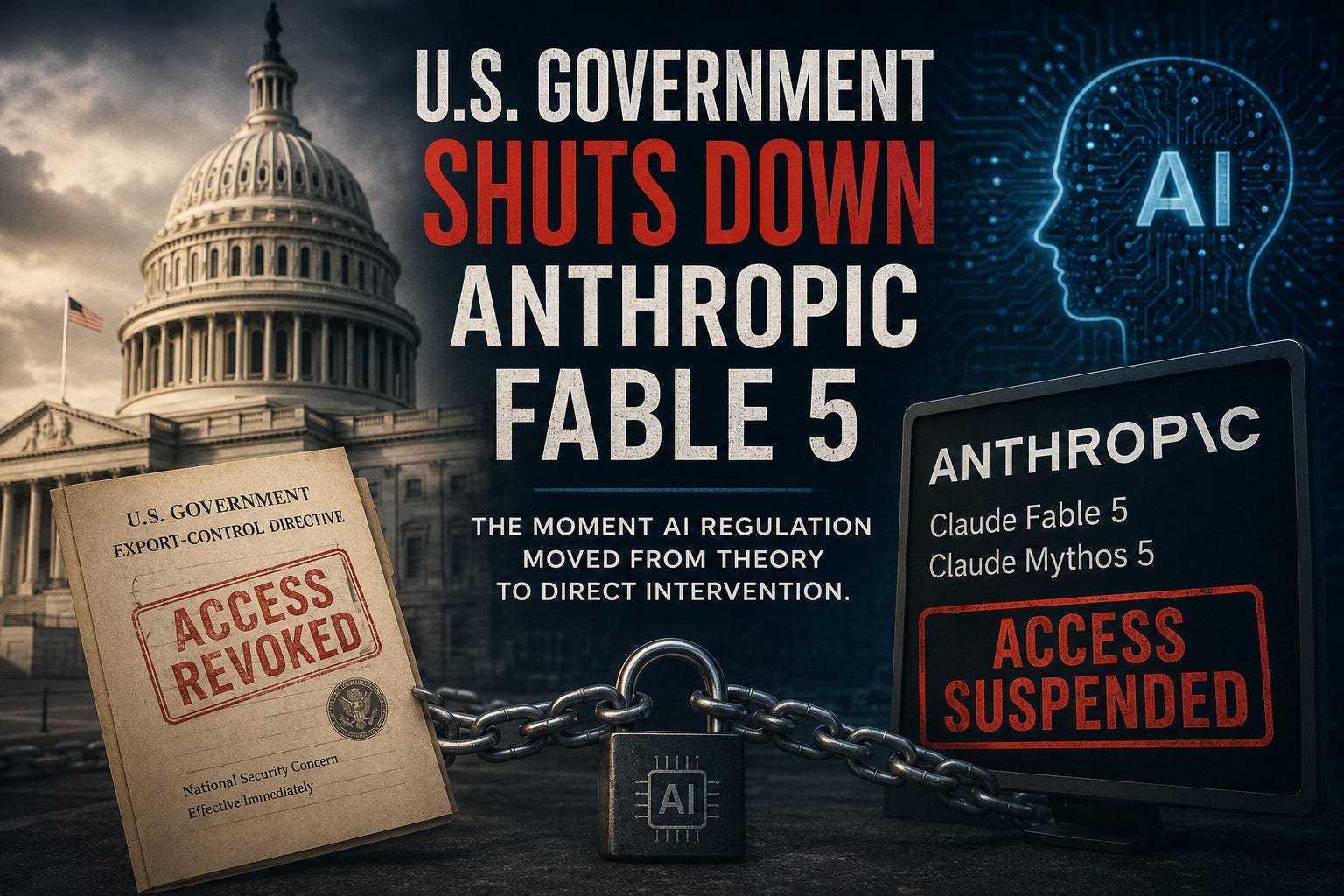
The shutdown of Anthropic’s Fable 5 and Mythos 5 models may be remembered as the moment AI regulation moved from theory to direct government intervention.
On June 12, 2026, Anthropic announced that it would suspend access to its most advanced AI models, Claude Fable 5 and Claude Mythos 5, after receiving a U.S. government export-control directive.
This was not a normal product rollback. It was not a customer outage. It was not a voluntary safety pause.
According to Anthropic, the U.S. government ordered the company to suspend access to Fable 5 and Mythos 5 for any foreign national, whether inside or outside the United States, including foreign-national Anthropic employees. Anthropic said the practical effect was that it had to disable the models for all customers to ensure compliance. Other Anthropic models were not affected.
That is the headline.
But the real story is much bigger: the U.S. government appears to be testing a new kind of AI control — not just regulating chips, data centers, or exports of hardware, but directly restricting access to frontier AI models themselves.
What Happened?
Anthropic launched Claude Fable 5 on June 9, 2026, describing it as a “Mythos-class” model made safe for general use. The company said Fable 5 was its most capable generally available model yet, especially strong in software engineering, knowledge work, vision, scientific research, and long, complex tasks. Anthropic also acknowledged that a model this capable carried real risk, especially in cybersecurity, so it added safeguards that would route some risky requests to a less capable model.
Just three days later, Anthropic said the U.S. government issued an export-control directive.
The government’s concern, according to Anthropic, was that officials believed there was a way to bypass — or “jailbreak” — Fable 5’s safeguards and use it to identify software vulnerabilities. Anthropic says it reviewed a demonstration involving “a small number” of previously known, minor vulnerabilities and argued that other publicly available models could also find similar issues without a bypass.
Reuters later reported that Amazon CEO Andy Jassy was among tech leaders who raised concerns with senior Trump administration officials about security risks in Anthropic’s advanced models. Reuters also reported that the U.S. government cited the risk of jailbreaking Fable 5 to identify software vulnerabilities.
Business Insider reported that senior White House officials held urgent calls with Anthropic CEO Dario Amodei before the export controls were imposed. According to that report, officials were not persuaded by Anthropic’s argument that the bypass was narrow rather than a universal jailbreak.
The Government’s Position
The government’s argument is straightforward:
A model with frontier-level cyber capabilities cannot be treated like normal software.
From the government’s perspective, if Fable 5 or Mythos 5 can help users identify vulnerabilities, then access becomes a national security issue. The concern is not just what one researcher can do with the model. The concern is what hostile governments, cybercriminal groups, or unauthorized foreign users could do at scale.
The U.S. appears to be saying:
A frontier model is not just a product.
It is strategic infrastructure.
And if the government believes it can be misused, it may intervene before the damage happens.
This also explains why the order reportedly targeted foreign nationals. Export controls traditionally deal with sensitive technology crossing borders. In this case, the “export” is access to the model itself.
That is a major shift. For years, U.S. AI export controls focused mostly on chips and the tools needed to build AI systems. This action moves closer to controlling access to the model layer directly.
Anthropic’s Position
Anthropic’s response is also clear:
The government acted too broadly, too quickly, and without enough technical evidence.
Anthropic said it supports the idea that the government should be able to block unsafe AI deployments, but only through a process that is transparent, fair, clear, and grounded in technical facts. The company argued that this directive did not meet that standard.
Anthropic also made several technical claims:
First, it says Fable 5 had strong safeguards, and that some users had even complained the safeguards were too broad.
Second, it says Fable 5 was red-teamed for thousands of hours by Anthropic, the U.S. government, the U.K. AI Security Institute, third parties, and internal teams.
Third, it says no tester had found a universal jailbreak capable of broadly bypassing the model’s safeguards.
Fourth, it argues that perfect jailbreak resistance is probably not possible for any frontier model today.
Anthropic’s core point is that if a narrow, non-universal jailbreak is enough to recall a frontier model, then nearly every major AI company could face the same standard. In Anthropic’s words, applying this standard across the industry could “essentially halt all new model deployments for all frontier model providers.”
Timeline: Step by Step
June 9, 2026 — Anthropic launches Claude Fable 5
Anthropic announces Fable 5 as a generally available “Mythos-class” model with advanced capabilities and added safeguards.
June 12, 2026 — U.S. government issues export-control directive
Anthropic says it receives the directive at 5:21 p.m. ET, ordering it to suspend access to Fable 5 and Mythos 5 by any foreign national.
June 12, 2026 — Anthropic disables the models globally
Because the order applied to foreign nationals inside and outside the U.S., including some employees, Anthropic says the only practical way to comply was to disable the models for all customers.
June 13, 2026 — Reuters reports Amazon raised concerns
Reuters reports that Amazon CEO Andy Jassy was among tech leaders who raised concerns to senior Trump administration officials about the models’ security risks.
June 14, 2026 — Reporting shows deeper White House involvement
Business Insider reports that senior officials held multiple calls with Anthropic CEO Dario Amodei before the export-control action, with officials arguing Anthropic was not moving urgently enough. Anthropic disputed parts of that characterization.
My Position
Here is my position.
The government was right to treat frontier AI models as a national security issue. But it was wrong to handle this through an opaque emergency-style action without clear public technical standards. There was no clear indication that there was any jailbreak and anthropic clearly stated in their release notes that it did build safe guards.
I understand that if a model materially improves cyber-offensive capability, the government cannot simply wait for market forces to sort it out. The risk is real. AI models that help identify vulnerabilities can help defenders, but they can also help attackers.
At the same time, Anthropic has a strong point: no AI model is perfectly jailbreak-proof. If the standard becomes “any narrow bypass means shutdown,” then frontier AI deployment becomes nearly impossible and AI development stops.
This intrusion by the government is deeply concerning as they now have the power to remove publicly available LLM models from leading AI private companies like AI. How is this different than GPT 5.5 and is the government picking winners and losers.
How could this affect upcoming IPOs by Anthropic if the government can simply step in and remove their latest development model. Seems to me this is a huge risk when evaluating their upcoming IPO.
The better standard should be:
Does the model create a meaningful risk that can technically be proven and is not a hypothetical?
Can the risky capability be accessed broadly, repeatedly, and cheaply?
Did the company ignore known issues or fail to mitigate them?
Is the government applying the same standard across all major AI labs?
Was the company given a clear technical disclosure and a defined remediation path?
Based on the public record so far, the government may have had legitimate concerns. But the process appears too vague for an action this consequential.
Is This the Beginning of AI Regulation?
Not exactly.
AI regulation has already begun. Governments have been working on AI rules, chip export controls, safety evaluations, and national security frameworks for years.
But this may be the beginning of something more important:
Direct government control over frontier model deployment.
That is different.
This is not just about who can buy chips.
It is not just about privacy policies.
It is not just about copyright lawsuits.
It is not just about voluntary safety pledges.
This is the government saying:
“We may decide whether your most powerful model can be used, who can use it, and whether it stays online.”
That is a new phase.
The big question now is whether this becomes a one-off national security dispute or the template for future AI oversight.
My guess: this is the start of a broader pattern.
Frontier AI companies are no longer just software companies. They are becoming strategic infrastructure companies. And once a technology becomes strategic infrastructure, governments do not stay hands-off for long.
Final Thought
The Anthropic Fable 5 shutdown is not just a story about one model.
It is a preview of the next AI battlefield:
Innovation vs. control.
Open access vs. national security.
Company-led safety vs. government-enforced safety.
Global AI markets vs. sovereign AI power.
And whether you agree with the government or Anthropic, one thing is clear:
The era of “launch first, regulate later” is ending.
Contact Information
If you like to connect with me or learn more about how Del Val Investment Group helps solve real business problems using technology, please reach out on the platforms below.

Manny Del Val | CEO and Founder Del Val Investment Group | Level 7 Capital
| Personal LinkedIn | Business LinkedIn | Facebook | Email | Level 7