


Dear Friends,
Before I start, I wanted to provide the financial example behind the article. All figures in the example are illustrative, not financials or from any acquisition I have evaluated. The 9% interest rate is a modeling assumption, not verified by any lender quote.
Purchase price: $2,000,000
Advertised SDE: $500,000
Financed amount (90%): $1,800,000
Annual debt service: $273,620
Advertised SDE: $500,000
Replacement Compensation: -($100,000)
Capital Expenditures: -($15,000)
Model Cash Available for debt service: $385,000
Baseline Model DSCR: 1.41x
Annual cash after debt: $111,380
The model assumes a 40% contribution margin on lost revenue meaning every $1 of declining sales reduces modeled cash available for debt service by $0.40 because some expenses decline with revenue and some remain fixed.
Exploring a 10% Downside here is what the numbers look like:
Annual Revenue: $2,250,000
DSCR: 1.04x
Cash Available for Debt Service: $285,000
Cash After Debt Service: $11,380
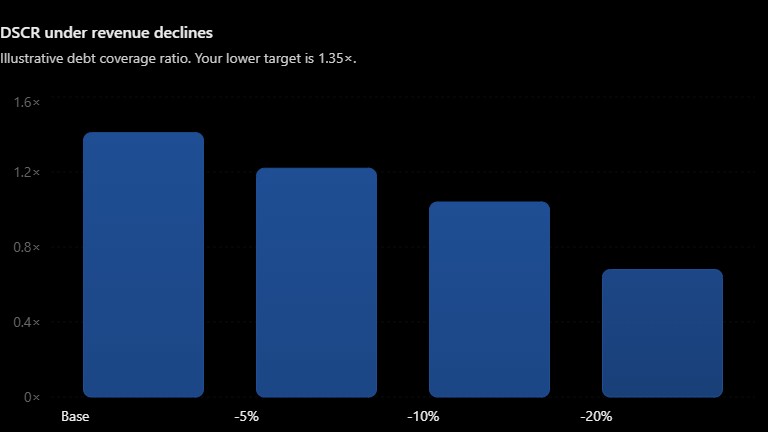
The modeled 10% decline leaves only approximately $11,380 in annual cash after debt service, before taxes and working-capital changes. At a 20% decline, the business experiences an approximately $88,620 annual debt-service shortfall.
This is why and emphasis on historical resilience, customer diversification, and working capital matters. A full-year annual model also cannot capture the additional danger of having several months with little or no cash receipts.
For the financing discussion, the SBA confirms that 7(a) financing can support business acquisitions and working capital, with most business-acquisition loans generally limited to a 10-year maturity. Its lending standards are governed by SOP 50 10, including the version effective October 1, 2026.
Now that you have the example above Imagine this:
You spend months searching for the right business. You have reviewed countless listings, spoken with brokers, met with sellers, and finally found something you are excited about and looks promising.
The business generates $2.5 million in revenue and has $500K in Seller Discretionary Earnings (SDE).
Asking Price? $2 million.
You negotiate the deal, obtain financing, and finally become the owner fo a business generating half a million dollars of advertised annual earnings.
Sounds Exciting Right?
Now Imagine three months later:
Revenue drops by 10%. A major customer delays payment. Payroll is due Friday and your SBA loan payment is coming up.
Suddenly, that $500K SDE number doesn’t look nearly as impressive.
Welcome to the difference between buying a profitable business and owning a financially sustainable one.
This week, I am taking it apart something every acquisition entrepreneur needs to understand before committing to purchasing a business and going through the LOI and acquisition process. That is the cash flow risks hiding behind an attractive business listing.
The $500,000 SDE illusion
One of the first things I look at when evaluating a business is its SDE, but I don’t stop there. SDE is intended to represent the financial benefit available to a single owner operator before certain discretionary and owner-related expenses. It can be useful for comparing smaller businesses, but it’s not the same as cash available to pay acquisition debt.
I want to understand the actual adjusted EBITDA, the bottom-line profitability, and how much sustainable cash the business generates.
Let’s use a hypothetical example:
Annual revenue: $2,500,000
Advertised SDE: $500,000
Asking price: $2,000,000
SDE multiple4.0×
A 4.0× SDE multiple is already higher than the 3.0×–3.5× range I generally prefer, although certain industries and quality businesses can justify higher multiples.
My next question is simple:
How much of that $500,000 is actually available after accounting for what it costs to operate the business?
For this example, let’s assume:
$100,000 in fully loaded replacement management compensation.
$15,000 in annual maintenance capital expenditures.
No additional existing business debt.
That reduces our modeled cash available for acquisition debt service to $385,000.
And we haven’t made an SBA loan payment yet.
Now comes the debt
Let’s assume we purchase the business with 90% financing.
Our hypothetical SBA loan is $1.8 million, amortized over 10 years at an assumed 9% annual interest rate.
That produces approximately $22,802 in monthly payments, or $273,620 annually.
Remember, this is an illustration, not a lender quote. Actual terms depend on the financing structure and lender approval.
Here’s what our financial picture looks like:
Advertised SDE: $500,000
Replacement management compensation: ($100,000)
Maintenance capital expenditures: ($15,000)
Cash available for debt service$385,000
SBA acquisition debt service($273,620)
Cash remaining before taxes and working-capital changes: $111,380
That $500,000 SDE has now become approximately $111,000 in modeled annual cash flow after debt payments.
That’s before income taxes, working-capital increases, unexpected costs, or additional investments in the business.
Not quite the same picture as the original listing.
The metric I pay close attention to: DSCR
Debt Service Coverage Ratio (DSCR) tells you how much cash flow is available relative to required debt payments.
In our example:
$385,000 ÷ $273,620 = 1.41× DSCR
Personally, I prefer an acquisition to support approximately 1.35×–1.50× DSCR.
That’s my investment discipline, not a universal lender requirement.
I want enough room for the business to experience an unexpected expense or decline in performance without immediately jeopardizing its financial stability.
And importantly, I don’t want an acquisition to work only because I’m assuming aggressive future growth.
I want the historical earnings and cash-flow profile to support the debt.
What happens when revenue declines?
This is where I believe too many buyers stop short in their underwriting.
They look at the historical financials, calculate the loan payment, see positive cash flow, and move forward.
But what happens if revenue declines?
When I evaluate an acquisition, I like to run at least three scenarios:
A 5% decline, a 10% decline, and a 20% decline.
I then examine what those scenarios do to cash flow, DSCR, owner compensation, and liquidity.
Let’s run our hypothetical business through those scenarios.
For simplicity, we’ll assume that each dollar of lost revenue reduces available cash flow by $0.40 because some expenses are variable while others remain fixed.
Scenario Cash Available for Debt DSCR Cash After Debt
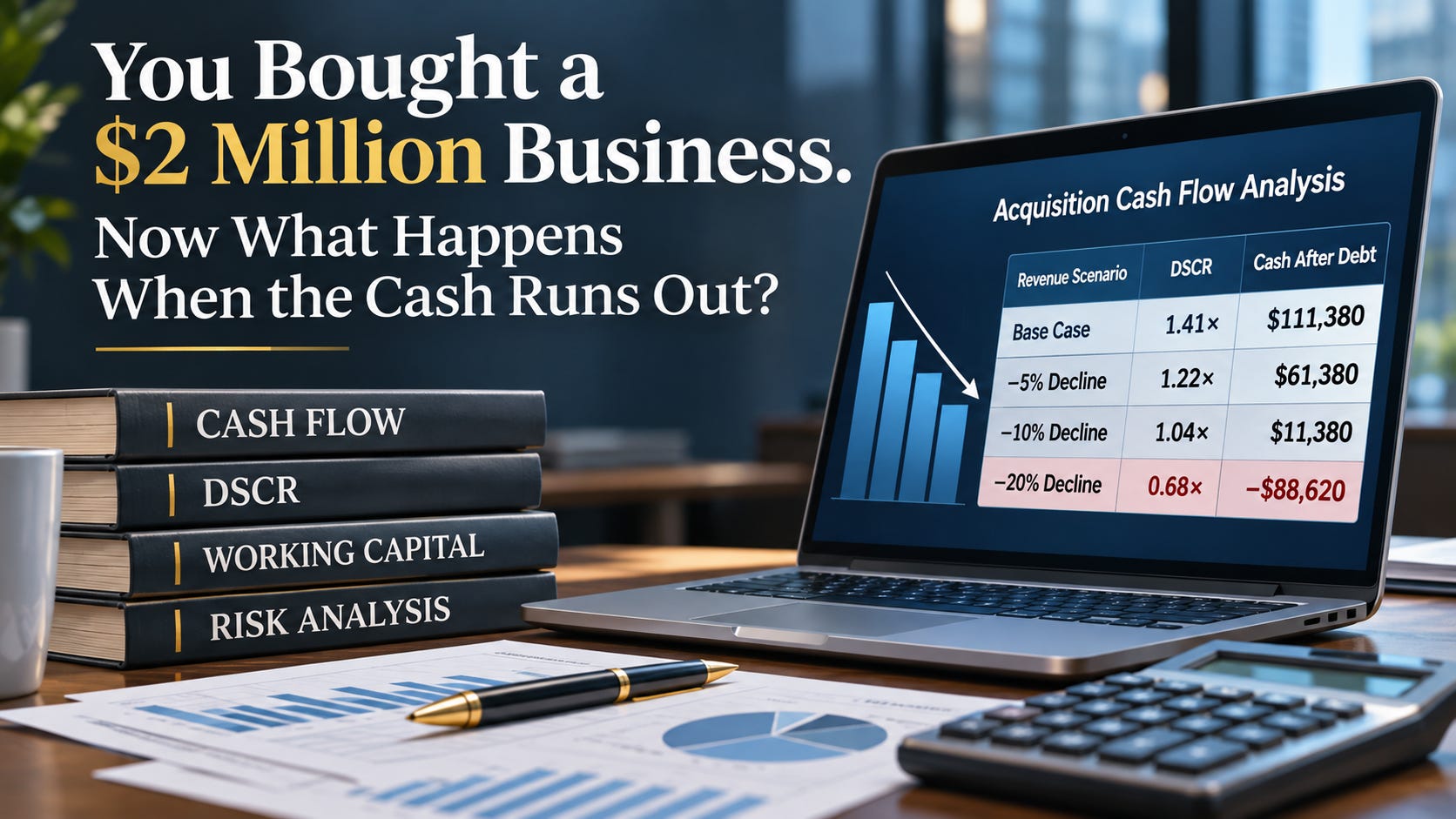
Base Case $385,000 1.41x $111,380
5% Downturn $335,000 1.22x $61,380
10% Downturn $285,000 1.04x $11,380
20% Downturn $185,000 0.68x $-(88,620)
These are illustrative annualized figures, not a forecast for any specific business.
Look at the difference.
At a 5% revenue decline, the business still covers its acquisition debt, but DSCR falls below my preferred minimum.
At 10%, there’s almost no annual cash cushion remaining after debt service.
At 20%, modeled operating cash flow isn’t sufficient to cover the scheduled payments.
The business didn’t have to fail for the acquisition to become financially stressful.
Revenue simply declined while significant expenses and debt obligations remained.
And this doesn’t even account for the timing of customer payments.
A business can generate accounting profits and still run short of cash because customers haven’t paid.
Not every 20% downturn deserves the same probability
Here’s where I believe experience and understanding the business matter.
Suppose I’m evaluating a company that has operated for 35 years, has a diversified customer base, and has never experienced a revenue decline greater than 7%.
I would still model a 20% downturn. But if its industry, contracts, and business model remain stable, I might consider the probability and duration of that event differently than I would for a newer company.
Now compare that with a five-year-old business that has already experienced a 10% revenue decline and hasn’t operated through a significant economic downturn.
That deserves more caution.
Neither scenario guarantees the future.
Historical performance is evidence, not protection.
My goal is to understand the financial consequences of each scenario and make a judgment about the business’s ability to withstand it.
A real acquisition I walked away from
I recently evaluated a business that taught me a great deal about the relationship between revenue, owner dependency, and working capital.
I’m keeping the business anonymous because the details of the transaction are private.
At first, I saw an opportunity, but as I reviewed the financial information, several concerns became difficult to ignore.
The three largest customers represented nearly 75% of revenue.
Recurring revenue was limited.
The monthly revenue pattern was extremely uneven.
Some months generated more than $500,000 in revenue.
Other months generated virtually nothing.
Think about that for a moment. The business could have an outstanding month followed by a period with little or no revenue.
But payroll doesn’t disappear. Rent doesn’t disappear. Operating expenses don’t disappear and acquisition debt doesn’t disappear.
There was another concern: sales depended heavily on one of the existing owners.
The business didn’t have an established independent sales team capable of consistently generating new business.
So, I wasn’t just evaluating customer concentration. I was evaluating customer concentration, sales dependency, revenue volatility, and working capital requirements simultaneously.
I tried to structure a solution
I didn’t immediately walk away. I explored ways to make the transaction workable.
I discussed the working capital required to operate the business through periods of limited collections.
Because the sellers were considering remaining as minority partners, I wanted clearly defined salaries and a revised incentive structure.
Rather than continuing the existing bonuses, I proposed performance incentives tied to sales results and the conversion of one-time sales into recurring revenue.
I also explored seller financing to help balance the transaction’s risk.
My thinking was straightforward.
If the business was going to have unpredictable sales, I wanted a structure that encouraged consistent revenue generation while preserving operating cash.
Ultimately, we couldn’t reach an agreement on the combination of valuation, working capital, seller financing, compensation, and operating risk.
So, I walked away. Did I waste my time?
I don’t believe so.
I gained valuable experience, built financial models using AI, and worked with an SBA broker to understand what would be required to finance the transaction.
I didn’t spend money on outside due diligence during that process.
In fact, experiences like this helped me develop an AI acquisition screening tool that evaluates deal risk, cash flow, DSCR, financing feasibility, and the confidence level supported by the information provided.
The tool is being prepared for other acquisition searchers, but the lesson here isn’t about software.
It’s about having a process that helps you recognize risk before you commit your capital.
Sometimes the best acquisition decision is the one you decide not to make.
Working capital: the money nobody celebrates
Now let’s go back to our $2 million example.
Assume you’re contributing $200,000 as your equity injection.
Add an illustrative $60,000 in closing-related costs.
You’ve already committed $260,000 before accounting for operating reserves, assuming those closing costs are paid separately.
For me, that isn’t enough.
I generally want to plan for three to six months of operating expenses in available working capital or liquidity, depending on the business.
The actual requirement needs to reflect the nature of the company.
A business with reliable monthly contracts, quick customer collections, and predictable expenses may require a different reserve than one dependent on large projects and customers who pay in 60 or 90 days.
I want to know:
How much cash is needed between billing customers and receiving payment?
What are the fixed monthly obligations?
Are there seasonal fluctuations?
How much inventory or equipment investment is required?
How long could the business operate if revenue or collections slowed?
And I want to distinguish the working capital included in the transaction from additional cash I need to retain after closing.
A cash reserve isn’t the same as additional profit. It’s financial protection.
My first 90 days wouldn’t be about changing everything
Another mistake I want to avoid as a new owner is immediately trying to transform a business I haven’t fully understood.
I would focus the first 90 days on stability.
Protect the customers.
Retain the key employees.
Understand the operating expenses.
Establish financial visibility.
Four controls would be particularly important.
First, a rolling 13-week cash-flow forecast.
Every week, I want to see expected collections, payroll, debt payments, vendor obligations, and the projected ending cash balance.
Second, a weekly financial dashboard.
I want visibility into revenue, margins, available cash, and upcoming debt obligations.
Third, accounts receivable and accounts payable monitoring.
A profitable sale doesn’t pay payroll until the cash is collected.
Fourth, monthly budget-to-actual reviews.
I want to know where actual performance differs from the assumptions used to acquire the business.
If my cash forecast starts showing a potential shortfall, I want to act early.
That might mean accelerating customer collections, reducing discretionary spending, delaying nonessential purchases, adjusting owner distributions, or reviewing available financing options.
The point is to have choices before liquidity becomes a crisis.
What about paying yourself?
I also think buyers need to separate two different questions.
What does it cost to replace the owner?
And how will I personally compensate myself?
For underwriting, I would use an appropriate market-rate salary based on the responsibilities required to operate the business.
After acquisition, I might consider a salary-and-distribution approach depending on the business structure, tax requirements, and available cash flow.
However, distributions aren’t guaranteed, and compensation needs to comply with applicable tax rules.
For example, S corporation shareholder-employees are subject to reasonable-compensation requirements.
That’s a discussion to have with your CPA or qualified tax professional, not something to decide solely by looking at how much cash is in the bank.
Before you sign the LOI
If you’re a first-time acquisition entrepreneur, here’s the advice I would give you.
Before you get too excited about the revenue, EBITDA, or SDE, understand how the business actually works.
How does it make money?
Does it have established systems and employees who can operate independently?
Or is everything dependent on the current owner?
Do you understand the industry?
Have you met the sellers?
Can you genuinely see yourself running this business?
Only then would I start thinking seriously about how to improve and grow it.
Get preliminary financials. Understand the major risks. Speak with an SBA lender or qualified financing broker to evaluate whether the acquisition appears financeable and at what valuation.
Then consider submitting an LOI.
An LOI is typically intended to be nonbinding as to the actual acquisition, although certain provisions can be legally binding. Have qualified counsel review it.
There’s nothing wrong with becoming passionate about an opportunity.
Passion can motivate you to do the work, but it cannot replace disciplined underwriting.
My final thought
I believe buying an existing business can be an excellent way to become an entrepreneur.
But acquiring a business and successfully operating one are two very different challenges.
The asking price is only one piece of the equation.
You need sustainable earnings.
You need enough cash to service debt.
You need a reasonable compensation structure.
You need working capital.
And you need enough financial flexibility to withstand problems you didn’t anticipate.
A good acquisition isn’t simply one that produces an attractive return when everything goes according to plan. It’s one that has a reasonable chance of surviving when things don’t.
That’s the difference I look for and it’s why I’m willing to walk away from a deal that doesn’t make financial sense, regardless of how much I like the opportunity.
Because at the end of the day, you aren’t just buying the earnings.
You’re assuming responsibility for the cash flow.
I’d like to hear from you: If you were buying a $2 million business generating $500,000 in advertised SDE, what would worry you most: customer concentration, debt service, working capital, or the quality of the earnings?
Share your perspective in the comments.
Contact Information
Who am I?
I have been in Information Technology for over 25 years at various roles from Systems Engineering to Director level positions. I have also been in real estate since 2019 focusing on fix and flips and in 2023 we shifted our focus to commercial real estate investing. I have acquired 246 units and continue to pursue real estate investments. I also have a Technology Firm helping companies incorporate technology, build systems integrations, understand cybersecurity, business continuity, disaster recovery, and solve complex business problems. For more information visit Del Val Investment Group. We also build custom software an example of this was our Multifamily Deal Evaluator application that was built for commercial multifamily operators with an operator, syndicator, and investor perspective so that anyone can learn to underwrite, analyze, and evaluate deals. If you are interested in the tool, you can check it out at KeptDo MFDA PRO.
In late November we plan to release our second application which will be geared to searchers looking to acquire businesses. We feel there is a lot of apps working on being a deal aggregator or helping you find deals we are focusing more on getting you organized, contacting you with the right people to bring you deals, getting you in contact with a deal team, providing education so you can understand the process, and most importantly helping you evaluate deals and create a plan to minimize risks and maximize growth.
If you like to learn more about what we do to help small and mid-size businesses get more customers, make each customer worth more, stay secure, and spend less to service the please visit Del Val Investment Group.
We are also looking to purchase cash flowing online virtual businesses or businesses in Central Florida. We are looking for business that have been in existence for at least 10 years, have a least $1 Million in revenue, and have an established sales process. If you are looking to sell your business and it meets these criteria I would like to talk to you.
Outside of my family, my dog, and my Miami Hurricanes my passion is business, technology, and real estate. We are always looking to purchase businesses that have a unique niche and serve our vision of solving real world business problems with technology and we are always looking for JV real estate opportunities we can operate or invest in as joint partners.
If you would like to reach out or learn more about my background, or if you have a business, you are looking at selling or looking for a partner, or if you want to invest with us feel free to connect with me on the following platforms.

Manny Del Val | CEO and Founder Del Val Investment Group
Personal LinkedIn | Business LinkedIn | Facebook | Email
Taking It Apart explores the realities of buying businesses, investing in real estate, and using technology to make better decisions. The goal isn’t to pretend every opportunity works. It’s to understand why some do and others don’t.
Financial examples are illustrative and are not investment, lending, legal, or tax advice. Consult qualified professionals before making acquisition or financing decisions.
Alot of buyers dont realize that SDE is not bottom line. I think that is where most mistake happen.
Splitting SDE from what is left after the replacement salary and debt service is where a lot of new owners get surprised. Which line do buyers misjudge most?